

Choosing an ecommerce website design company in Singapore isn’t just a task to check off your list—it’s the decision that defines your brand's future. This isn't about getting a website built. It’s about commissioning a growth engine engineered to drive revenue, inspire loyalty, and scale with your ambition.
Your Ecommerce Platform Is Your Growth Engine
In Singapore’s hyper-competitive market, your ecommerce website cannot be a static brochure. It is the heart of your business, powering every growth strategy you deploy. This makes your choice of design partner less like hiring a vendor and more like forming a strategic alliance.
You're building an asset designed to deliver results from day one. A top-tier ecommerce website design company in Singapore understands this. They don't just hand over the keys to a pretty site; they architect a conversion-focused ecosystem engineered for peak performance from the start.
The New Standard for Digital Partners
It's time to demand more than just aesthetics. A high-performance ecommerce system is built on three pillars working in unison:
- A Seamless User Experience (UX): Craft customer journeys so intuitive they turn casual visitors into passionate advocates.
- A Robust Technical Architecture: The foundation must be scalable, secure, and lightning-fast to handle growth without friction. For many ambitious brands, mastering a platform like Shopify is the first step. If you're new to the ecosystem, our guide on what is Shopify will bring you up to speed.
- Data-Driven Optimisation: Use real analytics to continuously refine the user experience and drive measurable improvements to your bottom line.
The opportunity is massive. Singapore's ecommerce market is projected to hit USD 116.3 billion in 2025 and soar to USD 332.0 billion by 2034. This explosive growth, fuelled by sky-high internet penetration and a mobile-first consumer base, makes a sharp, strategic design partner essential to claiming your share.
Your platform should simplify complexity, not create more of it. The right partner builds a system that empowers your team to focus on growth, confident that the technology can keep pace with your vision.
To truly unlock your platform's potential, you need to master the evolving core principles of ecommerce. This guide reframes how you approach the selection process, setting a new standard for what your brand should expect. We're focusing on the business outcomes that define success, giving you the clarity to make a choice that will accelerate your momentum.
Evaluating a Partner’s Technical and Strategic Depth
A beautiful website that doesn’t convert is just an expensive digital brochure. True ecommerce excellence ignites at the intersection of stunning design, rock-solid technology, and sharp business strategy. When choosing a partner, you're looking for a team that masters all three to ensure your investment accelerates growth, not just your overheads.
This is about digging deeper than a portfolio. You need an ecommerce website design company in Singapore that thinks like both a CTO and a CMO. They must translate your business goals into flawless technical execution and, most importantly, measurable results.
Anything less is a compromise you cannot afford.
This diagram shows how a high-performance ecommerce site acts as a growth engine, powered by user experience (UX), technology, and data working in tandem.
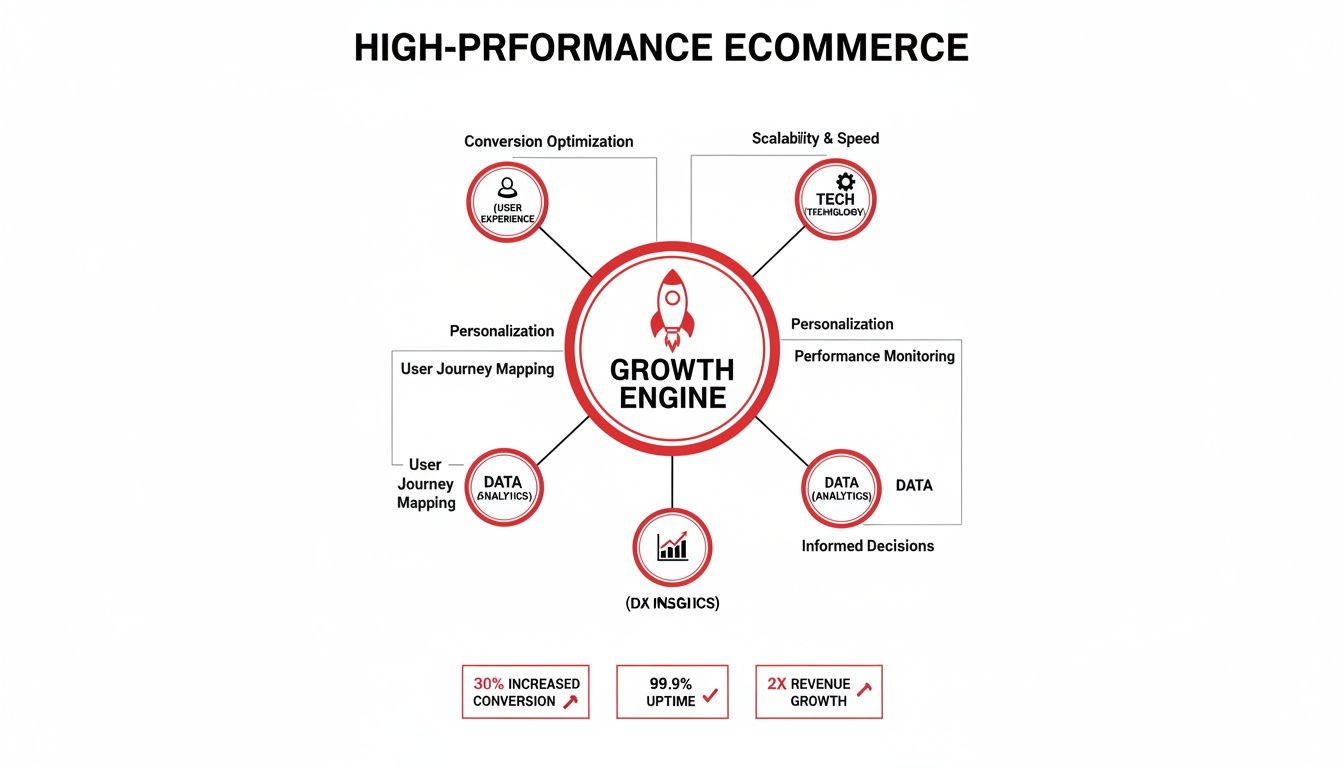
These aren't separate pillars; they are interconnected systems. They must work in perfect harmony to drive sustainable growth. A crack in one area will compromise the entire structure.
Platform Mastery Is Non-Negotiable
Your ecommerce platform is the foundation of your entire online business. A top-tier agency doesn’t just use a platform; they command it with deep, specialised expertise. For ambitious brands, a scalable solution like Shopify is often the clear choice, but genuine expertise goes far beyond a basic setup.
A true partner understands the platform’s architecture inside and out. They know its limits and—more importantly—how to creatively push past them. This mastery is what enables them to build a resilient, future-proof tech stack that supports your vision, whether that involves international expansion, complex product catalogues, or a seamless omnichannel experience.
Beyond Templates: Custom Development and Integrations
Growth always brings complexity. Your business will eventually require features that are not available out of the box. This is where an agency's technical depth is truly tested. A partner who only knows pre-built templates will hit a wall. One with serious development muscle can build custom solutions to solve your unique challenges.
Look for these critical capabilities:
- Custom Shopify Apps: Can they build proprietary apps to create unique customer experiences or streamline back-end workflows that give you a competitive edge?
- Third-Party Integrations: How adept are they at connecting your store to essential business systems like ERPs, PIMs, and sophisticated marketing automation platforms?
- API Expertise: Do they have the skills to leverage APIs to create powerful links between different software, ensuring data flows smoothly and your operations run like clockwork?
An agency that confidently handles these tasks is one that can build a truly integrated commerce ecosystem that grows with you.
The right commerce architecture simplifies complexity, it doesn't amplify it. It should empower your team by automating processes and providing a single source of truth, freeing them up to focus on strategic growth.
Strategic Oversight: Data, CRO, and Customer Journeys
All the technical skill in the world is wasted without strategic direction. A premier ecommerce partner is relentlessly focused on business outcomes. They don’t just build features; they architect systems designed to move the needle on key metrics. This strategic layer separates a standard agency from a genuine growth partner.
Their strategic depth becomes clear in how they approach:
- Conversion Rate Optimisation (CRO): This must be a data-driven process of continuous improvement. They should use A/B testing, heatmaps, and user behaviour analysis to find and eliminate friction points in the customer journey.
- Data & Analytics: They must be able to not just track metrics but pull actionable insights from them. They should help you define KPIs that align with your business goals and build dashboards that provide clarity, not confusion.
- Customer Journey Mapping: This requires a deep understanding of how customer segments discover, evaluate, and purchase from your brand. This insight informs every design and development decision, ensuring the final site is perfectly aligned with user expectations.
When vetting a potential partner, grill them on these areas. Ask for their CRO process or how they would tackle an ERP integration. Their answers reveal whether they are order-takers or strategic thinkers ready to catalyse your brand’s next chapter.
Designing for the Modern Singaporean Shopper
In Singapore, your customer's first impression happens on their phone. The modern shopper here didn't just adapt to mobile; they were born into it. They are digitally fluent, savvy, and have zero patience for anything less than instant gratification. A website not built for a smartphone is a closed door to sales.
This is where a top-tier ecommerce website design company in Singapore changes the game. They don't just talk about being "mobile-friendly." They live a "mobile-first" philosophy. This isn’t jargon; it’s a fundamental shift in approach. It means the entire customer experience—from discovery to checkout—is designed from the ground up for the small screen, feeling effortless, not like a scaled-down afterthought.

Mobile's dominance is reshaping the country’s retail landscape. The numbers are undeniable. Projections show that by 2025, smartphones will account for a staggering 77.58% of B2C checkouts. The market itself is forecast to grow at an 11.76% CAGR through 2031. This explosive trend, fuelled by widespread 5G and seamless biometric payments, makes one thing crystal clear: your site must perform like a native app. You can explore the data on Singapore's ecommerce market trends at Mordor Intelligence.
Performance Is the New Brand Promise
A slow-loading website is the digital equivalent of a long queue. Today's shoppers won't tolerate it, and neither will search engines. Website performance is no longer a technical detail; it's a core part of your brand and a make-or-break factor for user experience.
A forward-thinking agency is obsessed with speed. They know that every millisecond of loading time erodes conversion rates and tarnishes your brand's reputation.
A fast, seamless mobile experience isn’t a feature—it’s a promise. It’s a sign of respect for your customer's time that builds the trust required to create loyal fans.
This obsession with performance is measured with hard data. An expert partner will build your site using Google's Core Web Vitals as a non-negotiable benchmark. These vitals measure real-world user experience, focusing on:
- Largest Contentful Paint (LCP): How fast does the most important content appear?
- First Input Delay (FID): How quickly does the site react when a user clicks something?
- Cumulative Layout Shift (CLS): How visually stable is the page?
Nailing these metrics signals to Google that your site provides a great experience, which can boost your SEO rankings and unlock more organic traffic.
Architecting a Mobile-First Customer Journey
Designing for mobile is more than shrinking your desktop site. It’s about rethinking the customer’s path from start to finish, prioritising clarity and maintaining momentum with every tap.
A skilled agency architects this journey with surgical precision. They simplify navigation to make finding products intuitive. They ruthlessly streamline checkout forms, eliminating every non-essential field to combat cart abandonment. They integrate mobile-native features like tap-to-call buttons and one-click digital wallets to create a frictionless path to purchase. This is where mastering a platform's capabilities, like those we explore in our guide to the best Shopify web designs, becomes a massive competitive advantage.
The goal is to create an experience that feels less like a website and more like a sleek, high-performance app. It’s about delivering the speed and simplicity that modern Singaporean shoppers don’t just want—they expect.
Identifying Red Flags and Green Lights in a Partner
Choosing an ecommerce website design company in Singapore is a strategic commitment. This isn’t a one-off project; you're forming a partnership that will directly shape your brand’s growth for years. To make the right call, you need to look past the sales pitch and understand an agency’s process, culture, and genuine investment in your success.
The best partners leave clear signals of their quality. At the same time, a poor fit often reveals early warning signs. Spotting the difference between these "green lights" and "red flags" is the key to ensuring your new site accelerates your business, not stalls it.
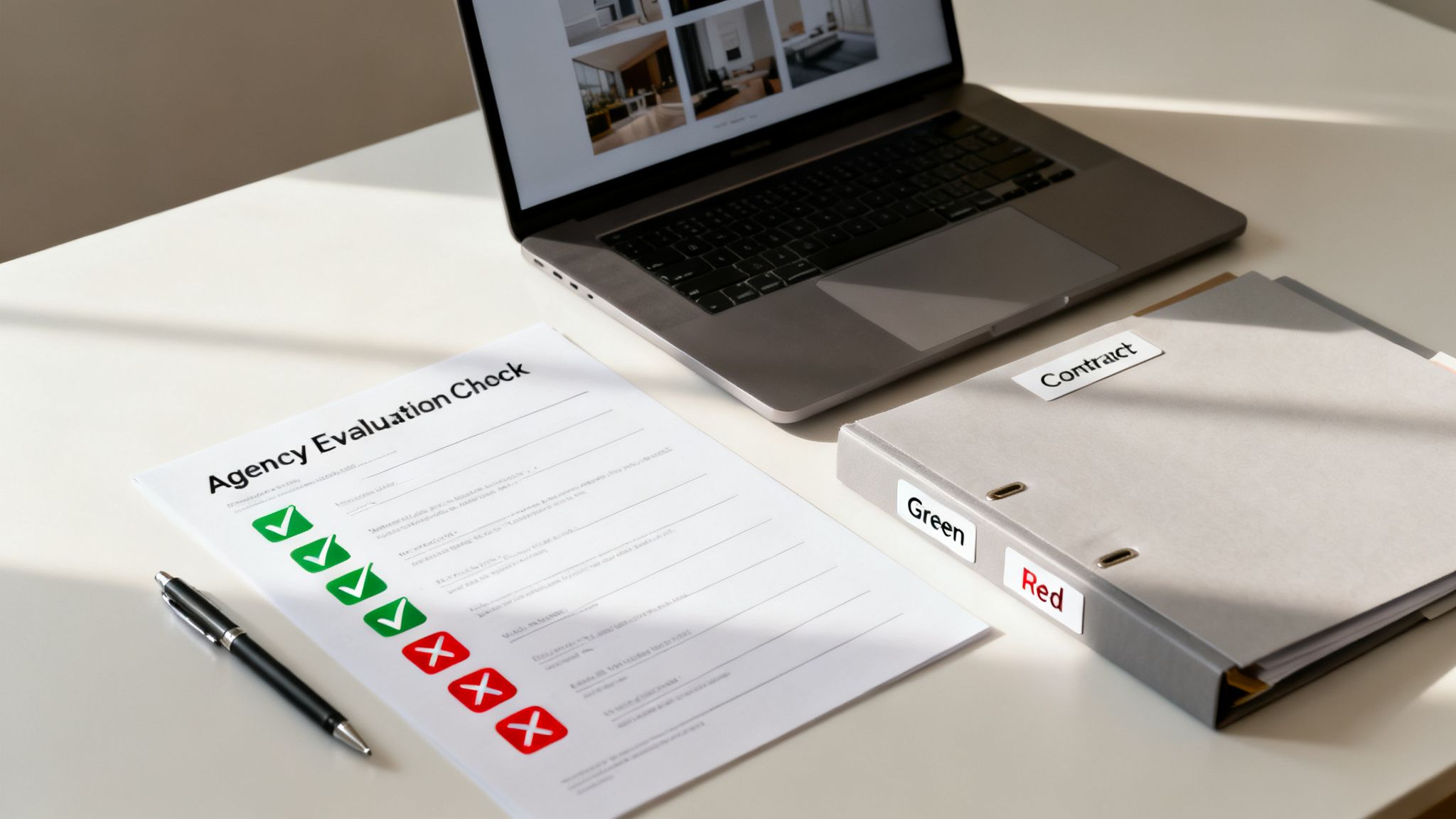
Green Lights That Signal a True Growth Partner
A top-tier agency operates with a strategic foresight that immediately sets them apart. They aren’t just there to build a website—they’re there to build a relationship grounded in trust and shared goals.
Look for these unmistakable green lights:
- A Relentless Focus on Data and Outcomes: Every conversation loops back to your business goals. They ask about your KPIs, customer lifetime value, and target conversion rates. Their proposals are built around hitting measurable results, not just a feature list.
- A Transparent and Structured Process: They can walk you through their entire project plan, from discovery to launch and beyond. You see detailed timelines, clear milestones, and a predictable communication rhythm. This structure eliminates ambiguity and gives you clarity at every step.
- A Portfolio of Complex, Successful Projects: Look past the pretty designs. Do their case studies show they solve tough technical problems, like developing custom apps or handling tricky third-party integrations? This is proof they have the expertise to support you as you scale.
- Proactive Communication and Strategic Input: A true partner doesn’t wait for instructions. They bring new ideas to the table, challenge your assumptions, and keep you updated on industry trends. They should feel like an extension of your own team.
The best partnerships are built on proactive collaboration. Your agency should feel like a strategic advisor who is just as committed to your bottom line as you are.
Red Flags That Expose a Poor Fit
On the flip side, some behaviours should give you immediate pause. These red flags often point to an agency more interested in its own profits than your long-term growth. They want to close a deal, not deliver sustainable value.
Be wary of these warning signs:
- Vague or Generic Proposals: If a proposal feels like a copy-paste job and lacks specifics on deliverables, timelines, or the why behind their recommendations, it’s a huge red flag. This signals a cookie-cutter approach not designed for your business.
- An Over-Emphasis on Aesthetics Over Functionality: A beautiful design is great, but it’s worthless if it doesn’t convert. An agency that talks endlessly about visual trends but can’t explain how their design choices will improve UX or drive sales is missing the point.
- A One-Size-Fits-All Approach: If they push a specific solution without first digging deep into your business, customers, and operational challenges, they aren’t a partner. They’re a vendor trying to make a quick sale.
- No Clear Post-Launch Support Strategy: The work doesn’t end at launch. A reliable agency has a clear plan for ongoing support, maintenance, and optimisation. If they get cagey about what happens post-launch, they are only interested in the initial project fee.
Here is a quick checklist to sort the promising partners from the ones to avoid.
Agency Red Flags vs Green Lights
| Warning Sign (Red Flag) | Indicator of a Strong Partner (Green Light) |
|---|---|
| Vague, "one-size-fits-all" proposals. | Detailed proposals tied to your specific business KPIs. |
| Focus is entirely on looks and design trends. | Discussions centre on CRO, UX, and business impact. |
| Pushes their preferred solution before listening. | Asks deep questions to understand your unique challenges. |
| No clear plan for after the website launches. | Offers a structured plan for ongoing support and optimisation. |
| Communication is reactive and slow. | Proactively brings ideas and maintains clear communication. |
| Portfolio shows only simple, brochure-style websites. | Case studies demonstrate complex integrations and problem-solving. |
| Pressure to sign quickly without a discovery phase. | Insists on a thorough discovery process to align on goals. |
Choosing the right partner gives your brand momentum that lasts for years. By weighing these signs, you can confidently select an agency that will be a true catalyst for your growth.
How a Shopify Platinum Partner Accelerates Growth
When choosing an ecommerce website design company in Singapore, it’s easy to get lost in a sea of slick portfolios. But one credential cuts through the noise and signals true, top-tier capability: official partner status.
At the top of that pyramid sits the Shopify Platinum Partner.
This isn’t a fancy badge; it’s a massive strategic advantage for you. It means the agency is in the top 1% of Shopify experts on the planet. They have proven, time and again, that they can handle complex, high-stakes projects for ambitious, fast-growing brands.
Choosing a Platinum Partner like Jumpstart Commerce—the only one in Southeast Asia—transforms the entire relationship. It is no longer a client-vendor transaction. It becomes a growth alliance.
Unlocking an Insider’s Advantage
The single biggest benefit of working with a Platinum Partner is privileged access. It's the difference between having a ticket to the show and having a backstage pass. This access enables faster, more innovative, and more stable solutions for your brand.
Here’s how that translates to real-world impact:
- Get Tomorrow’s Features, Today: Platinum Partners get early access to new Shopify features and APIs. This means they can build solutions for you that your competitors won’t see for months, giving you a serious head start.
- A Direct Line for Emergencies: When a technical problem arises, a Platinum Partner doesn’t submit a standard support ticket. They have a direct line to Shopify’s senior engineering teams. Problems get solved in hours, not days, minimising downtime.
- Total Mastery of the Ecosystem: Platinum Partners have a deep, exhaustive understanding of Shopify. Every solution they build is based on proven best practices, from core architecture to the most advanced apps and integrations.
Partnering with the top 1% of experts isn’t about prestige—it’s about de-risking your investment. It ensures your growth is supported by a team that has solved the most complex commerce challenges for the world’s leading brands.
Turning Technical Muscle into Business Momentum
Those technical perks must translate into actual business results. The real power of a Platinum Partner is their ability to connect deep platform knowledge to your critical commercial goals. They turn features into revenue.
The opportunity in Singapore is huge. The B2C e-commerce market hit US$16.39 billion in 2024 and is projected to soar to US$25.50 billion by 2029. But in a market this crowded, a generic store won’t cut it. To stand out, you need excellence—a commitment that helped Jumpstart Commerce earn the Singapore Prestige Brand Award in 2024 and 2025. You can explore the data on Singapore's B2C ecommerce market trends to see just how big the playing field is.
This is where a premier partner proves their worth. They don’t just build a store that looks good; they architect a commerce engine designed to convert, scale, and adapt. They use their insider knowledge to anticipate challenges and build solutions that last.
The result is a website that doesn’t just keep up with your brand’s ambition—it actively accelerates it. For any brand serious about winning, understanding the value of working with certified Shopify Plus Partners isn't just important; it's essential.
Putting It All Together: Your Blueprint for Growth
You've done the work of understanding what separates a good agency from a great one. Now, it's time to take action. This isn't just about picking a vendor; it's about making a deliberate choice to stop settling for off-the-shelf solutions and start building for the future.
This is your moment to move from competing to leading. The plan below will help you shift from evaluation to execution, giving your team the confidence to make the right call.
How to Prepare for That First Big Meeting
Walking into a discussion with a potential agency unprepared is a missed opportunity. To get the most from these initial conversations, your team must be on the same page. The goal is simple: articulate your vision and your biggest headaches with absolute clarity.
Use this checklist to get aligned internally:
- Define What Success Actually Looks Like: What is the goal in the next 12-24 months? Be specific. A 20% lift in customer lifetime value? A 1.5% increase in conversion rates? Launching in two new markets?
- Map Out Your Must-Have Tech: List all your non-negotiable systems. This means your ERP, inventory management software, marketing automation tools, and 3PLs. Giving a potential ecommerce website design company in Singapore a clear tech map lets them gauge the complexity from day one.
- Pinpoint Your Biggest Growth Blockers: What's holding you back right now? Is it a clunky website that frustrates users? Manual backend tasks that consume your team's time? The inability to launch a promotion without calling a developer? Be honest about the friction points.
The quality of your brief directly dictates the quality of the solution you'll get. A sharp, strategic brief doesn't just get you a proposal; it empowers a great partner to build a genuine growth engine for your business.
Architecting Your Path to Market Leadership
Once you've done this prep work, you are in the driver's seat. You can lead the conversation instead of reacting to a sales pitch. This allows you to push potential partners on their strategic thinking, test their technical knowledge, and find a team as ambitious as you are.
As you think bigger, preparing for global expansion becomes critical. Knowing how to accept international payments, for instance, is a foundational piece of that long-term puzzle. This forethought turns the agency selection process from a vendor search into a strategic play for your future. With the right strategy and the right partner, you're not just building a store—you're building a commerce ecosystem that gets ahead of market demands.
A Few Common Questions
Choosing the right partner to build your digital flagship is a big decision. We’ve guided hundreds of brands through this process, and we've compiled answers to the most common questions.
How Much Does an Ecommerce Website Cost in Singapore?
The cost of an ecommerce website directly reflects your ambition. A simple, template-based site might cost around S$5,000, but for a serious, scaling brand, that approach often creates more problems than it solves.
For a custom, high-performance Shopify store built by a top-tier ecommerce website design company in Singapore, you should budget an investment between S$30,000 to over S$100,000. "Investment" is the right word—this is not a fee; it's capital deployed into your primary revenue-generating asset.
This price reflects the deep strategic work, custom development, complex integrations, and data-driven optimisation required to build a true growth engine. The best partners frame this cost against the potential return on investment (ROI), designing a platform that pays for itself many times over.
The real question isn't "What does it cost?" but "What's the potential return?" A cheap website is an expense. A strategic ecommerce platform is an investment that compounds over time.
What Is the Typical Timeline for an Ecommerce Website Project?
A professionally managed ecommerce project follows a structured, transparent timeline. For most custom builds in Singapore, the process takes between 12 and 20 weeks from kickoff to launch.
We break the project down into clear, sequential phases:
- Discovery and Strategy (2–4 weeks): We dive deep into your business goals, technical needs, and audience to create a strategic blueprint.
- UX/UI Design (3–5 weeks): We translate that strategy into wireframes and high-fidelity visual designs, crafting the ideal customer journey.
- Development and Integrations (6–8 weeks): Our developers bring the designs to life, configure the platform, and integrate all essential third-party systems.
- Testing and Launch (1–3 weeks): We conduct rigorous quality assurance testing across all devices, handle data migration, and manage the final deployment.
Complex challenges—like building a custom application or migrating massive amounts of data—can extend this timeline. Any reputable agency will provide a detailed project plan with clear milestones, so you always know exactly where things stand.
Should I Choose a Freelancer or an Agency?
For ambitious brands with a clear growth vision, an agency is the definitive choice. A freelancer may seem cost-effective for a basic site, but their capacity is fundamentally limited to one person's skillset and time.
An agency brings an entire ecosystem of expertise. You get a multi-disciplinary team of strategists, UX/UI designers, developers, and project managers working in sync. This integrated approach is crucial for solving complex business problems that go beyond visual design.
More importantly, an agency offers a strategic partnership focused on your long-term success. They have the resources to handle sophisticated technical architecture, provide ongoing optimisation post-launch, and scale with you as your business evolves. A freelancer’s scope is often confined to the initial build, leaving you without the strategic support needed for sustained growth. For any business serious about performance, the depth and reliability an agency provides are indispensable.
Ready to build an ecommerce platform that doesn't just keep up with your ambition, but accelerates it? Jumpstart Commerce is the only Shopify Platinum Partner in Southeast Asia. We design, build, and grow high-performing stores for the region’s most ambitious brands.










Leave a comment
This site is protected by hCaptcha and the hCaptcha Privacy Policy and Terms of Service apply.