

Scaling a high-growth brand demands more than a developer. It requires a true commerce expert. Shopify Plus Partners are exactly that: a highly-vetted group of agencies certified by Shopify to architect the future for ambitious brands.
They don't just build websites; they engineer complex commerce ecosystems designed to accelerate growth and dominate markets.
Why Elite Shopify Plus Partners Are Growth Catalysts
Scaling on Shopify Plus isn’t about launching a pretty website. It’s about engineering a commerce engine that anticipates what’s next. The choice of your partner is what separates market leaders from the brands that hit a plateau.
The conversation has evolved. Brands today need a fully integrated ecosystem that drives revenue, builds genuine customer loyalty, and eliminates operational friction. This is where the best Shopfolio Plus Partners excel. They don’t just complete tasks; they solve the fundamental challenges that unlock exponential growth.
Beyond the "Build" Mentality
Any standard agency can deliver a functional website. A true Shopify Plus Partner delivers a growth engine. Their focus is locked on solving the high-impact problems that determine whether a brand thrives in a competitive landscape. This demands a completely different mindset and a deeper, more strategic skillset.
Forget thinking about templates. Think custom architecture, engineered from the ground up to convert. This approach means mastering areas like:
- AI-Powered Conversion Optimisation: Using predictive analytics and machine learning to understand user behaviour, then relentlessly refining the customer journey to maximise every sales opportunity.
- Custom Application Development: Building bespoke apps and unique features that solve your specific business challenges or create an inimitable customer experience.
- Data-Driven Retention Systems: Designing sophisticated loyalty programs and automated communication flows that transform first-time buyers into lifelong advocates.
The right commerce architecture simplifies complexity rather than amplifying it. It’s the foundation that enables a brand to not just compete, but to define its category.
From Vendor to Strategic Partner
This focus fundamentally changes the relationship. A vendor waits for instructions. A partner challenges your assumptions, brings new ideas to the table, and ties their success directly to yours. They become an extension of your team, providing the strategic foresight and technical firepower required to win.
This is the exact value we champion, a commitment we celebrated when Jumpstart joined the Shopify Plus Partner Program.
That strategic alignment is everything. It means your partner is constantly thinking ahead—how to boost checkout conversion by another 2%, slash customer acquisition costs with smarter lifecycle marketing, or prepare your tech stack for international expansion.
Ultimately, engaging an elite Shopify Plus Partner is an investment in momentum. You tap into their deep platform expertise and strategic insight not just to build for today, but to design for the growth you're targeting tomorrow. They don't just help you react to change; they empower you to lead it.
Decoding Partner Tiers and Proven Capabilities
The Shopify ecosystem is vast, but not all partners are created equal. The first step to finding the right team is understanding the critical distinction between a standard Shopify Partner and a certified Shopify Plus Partner. This isn't just a title; it’s a clear signal of proven, enterprise-level expertise.
Standard Shopify Partners are the ecosystem's backbone, perfect for getting new businesses launched. They excel at store setup and the fundamentals. But when your brand is managing high-volume sales, complex backend operations, and targeting market leadership, you need more than the standard playbook. You need a specialist.
This is where certified Shopify Plus Partners enter the picture. This designation isn't given lightly. It's an earned certification, awarded by Shopify only to agencies who consistently deliver exceptional results for high-growth, enterprise-level brands.
A Shopify Plus Partner doesn't just build a store; they architect an entire commerce engine. Their portfolio is a testament to solving the exact complex challenges that fast-scaling brands inevitably face.
The "Plus" certification signifies that a partner has been rigorously vetted by Shopify for their technical skill, strategic thinking, and service quality. Here’s what that unlocks for you.
Shopify Partner Tier Capability Matrix
| Capability | Standard Shopify Partner | Certified Shopify Plus Partner |
|---|---|---|
| Ideal Client | Startups and small to medium-sized businesses. | High-growth, enterprise, and high-volume merchants. |
| Core Services | Basic store setup, theme customisation, app installation. | Complex migrations, headless builds, custom integrations. |
| Technical Scope | Works well within the standard Shopify framework. | Experts in custom solutions, API integrations, and scalability. |
| Strategic Input | Focuses on getting the store launched and operational. | Provides long-term growth strategy, CRO, and data analysis. |
| Platform Access | Standard partner support channels. | Direct, priority access to Shopify Plus support and teams. |
The table makes it clear: while both are valuable, they operate on different playing fields. A Plus Partner is equipped for the most demanding technical and strategic missions.
The Real Difference in Capabilities
So what does that "special forces" capability look like in action? It goes far beyond theme setup. The core competencies you gain access to are game-changers for any ambitious brand.
- Complex Technical Migrations: Moving a large-scale business from a platform like Magento or BigCommerce to Shopify Plus is a precision operation. Plus Partners have executed this countless times, ensuring a seamless transition that protects your data, SEO equity, and customer experience.
- Headless Commerce Architecture: For brands that demand total creative freedom and blazing-fast performance, Plus Partners decouple the frontend from the backend. This enables stunning, content-rich experiences that are impossible with a standard theme.
- Sophisticated Integrations: They are masters at weaving Shopify Plus into your entire business ecosystem, connecting to your ERP, CRM, third-party logistics (3PL), and inventory management systems to create a unified command center for your entire operation.
This journey from a simple store build to true market leadership is precisely what elite partners are designed to accelerate.
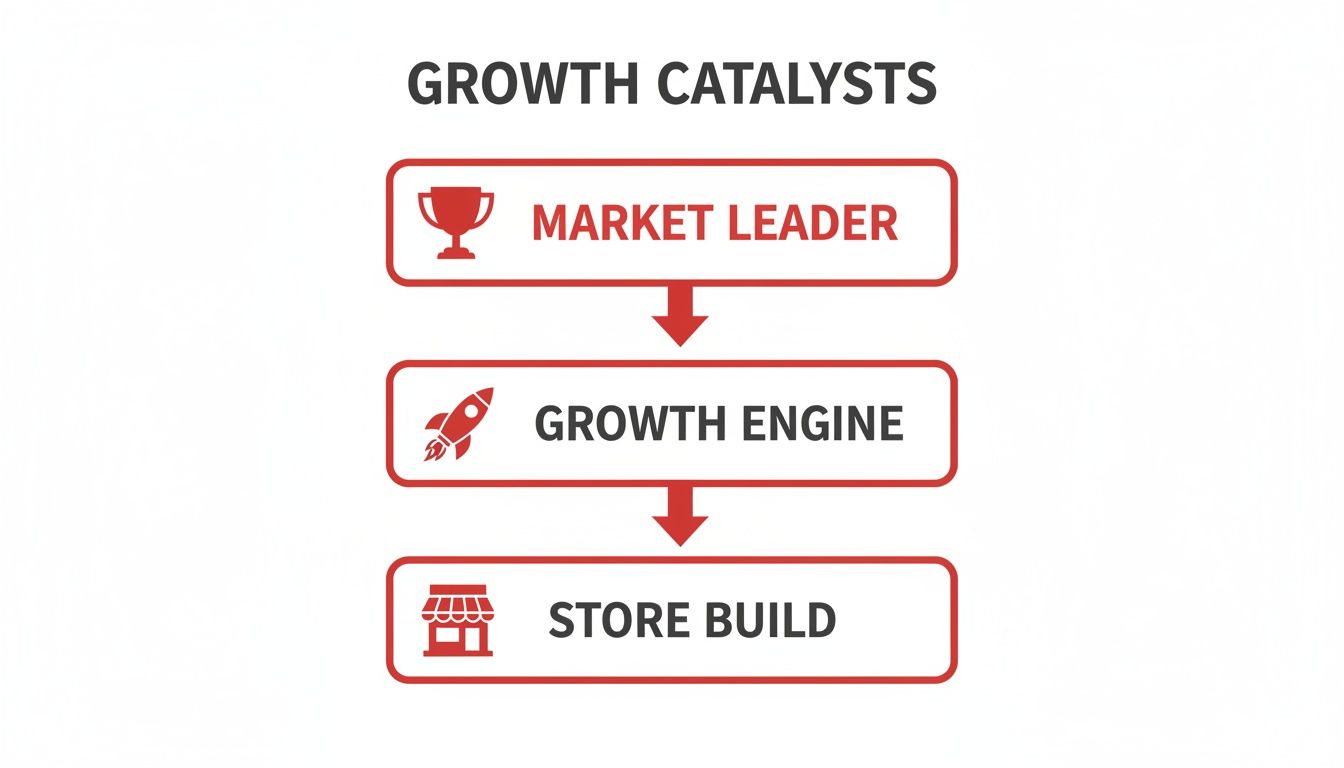
As the diagram shows, a solid store build is just the launchpad. The growth engine—powered by strategy, data, and advanced tech—is what transforms a brand into a market leader.
Validated Expertise and Platform Access
The greatest advantage is their direct line to Shopify’s product and support teams. This exclusive access isn't a perk; it’s a powerful tool for solving problems faster and ensuring their clients' needs are heard at the highest levels.
This special relationship unlocks:
- Early Access to Betas: Plus Partners are often the first to access new Shopify Plus features, giving their clients a significant competitive edge.
- Dedicated Partner Support: When a critical issue arises, they have priority channels and a dedicated Partner Manager at Shopify to accelerate resolution.
- Strategic Insights from Shopify: As part of an inner circle, they receive advanced roadmaps and strategic insights directly from Shopify, translating that insider knowledge into a concrete growth plan for your business.
Choosing a Shopify Plus Partner means you’re not just hiring an agency. You’re engaging a strategic ally with proven expertise and insider access. This ensures your technology doesn’t just keep pace with your growth—it actively drives it. To see what they can help you achieve, explore the many benefits of Shopify Plus. Their job is to turn all that platform potential into real-world performance and revenue.
The Blueprint for Evaluating Your Next Partner
Choosing the right Shopify Plus Partner is one of the most important business decisions you’ll make, shaping your growth trajectory for years. To get it right, you must look past slick portfolios and big-name client lists and conduct a structured evaluation. This is our blueprint for doing just that.
We’ll break down how to assess potential partners across five essential areas. This isn't about finding a team that can build a website; it's about finding one that will accelerate your entire business.

You’re not hiring a contractor. You’re looking for a strategic ally whose entire process is built on clarity, speed, and measurable results.
Digging into Their Technical Chops
Deep technical skill is non-negotiable. The quality of a partner’s code and their ability to architect complex solutions directly impacts your store's speed, security, and future adaptability. You need a team that can execute flawlessly, whether it’s a massive migration or a custom app build.
When vetting their technical skills, demand proof of:
- Headless Commerce Builds: Have they separated the frontend and backend for brands needing total design freedom and lightning-fast page loads? Get the specifics.
- Complex Data Migrations: Ask for war stories. How did they move a massive product catalogue, customer data, and order histories from a platform like Magento without downtime or data loss?
- Custom App Development: Can they point to bespoke apps they've built from scratch to solve a unique business problem that an off-the-shelf solution couldn't handle?
A great partner sees your tech stack not as a collection of separate tools, but as a single, fine-tuned engine for growth. Their job is to make every part work together flawlessly to boost performance.
Sizing Up Their Commerce Strategy
Technical skills are wasted without a smart game plan. The best Shopify Plus Partners are seasoned commerce strategists who understand the entire customer journey. They should challenge your thinking and bring fresh ideas that help you hit your business goals.
A partner with real strategic vision will demonstrate their value by:
- Tying technology to business results: They won't just recommend a technical fix; they’ll explain exactly how it will increase average order value or improve customer lifetime value.
- Thinking beyond launch day: They’ll present a long-term roadmap focused on continuous improvement and growth long after the site goes live.
- Getting to know your market: They should ask smart questions about your industry, competitors, and customers to shape their recommendations.
As you build your evaluation plan, it's helpful to review broader advice on finding the right digital marketing agency partner. It provides a wider lens to appreciate the blend of technical and marketing intelligence a true partner requires.
Putting Their Integration Capabilities to the Test
Your Shopify Plus store is the heart of your business, but it doesn't operate in a vacuum. It must connect seamlessly with your ERP, CRM, 3PL, and marketing platforms. A top-tier partner must be a master integrator, capable of building data flows that automate your operations.
Ask direct questions about their integration experience:
- Which specific ERP or inventory management systems do you work with most often?
- How do you handle data integrity and ensure real-time synchronisation?
- Walk me through the most complex, multi-system integration project you’ve managed.
An agency’s ability to connect these disparate systems is what transforms your e-commerce site into a unified command centre for your entire business.
Mastering Conversion Rate Optimisation
A gorgeous website that doesn't sell is just an expensive piece of art. The best Shopify Plus Partners are obsessed with conversion rate optimisation (CRO). They live and breathe data, using a structured process to improve every step of the customer journey, from the first click to the final thank you.
A solid CRO process is always built on:
- Hard Data Analysis: Using tools like Google Analytics and heatmaps to pinpoint exactly where customers are dropping off.
- Real User Research: Running user tests and surveys to understand the why behind the numbers.
- Disciplined A/B Testing: Having a structured method for testing ideas and rolling out the winners.
This focus on CRO is a game-changer. Certified partners in APAC are completing complex migrations in just 4 to 12 weeks. For high-revenue merchants, they’re delivering checkout optimisations that boost conversion rates by 15-18% on average.
Proving Their Data and Analytics Prowess
Finally, a world-class partner uses data to drive every decision. They are experts at setting up advanced analytics, tracking the right KPIs, and turning messy data into clear, actionable insights. Their ability to build and explain custom reports empowers you to make smarter business decisions, faster.
Look for a partner who can:
- Define a Measurement Strategy: They’ll work with you to identify the metrics that truly matter to your business, not just vanity numbers.
- Implement Advanced Tracking: They have the skills to set up sophisticated event tracking and custom dimensions in Google Analytics or other key platforms.
- Deliver Actionable Insights: Their reports shouldn't just tell you what happened. They need to explain why it happened and what you should do about it next.
By systematically grading potential partners against these five pillars, you can see past the sales pitch and find a team with the proven skills to solve today's problems and scale with you for years to come.
Getting the Real Story: Mastering the Interview and Vetting Process
You have your shortlist. Now comes the most important step. The interview and vetting process is where you peel back the layers of a polished sales pitch to see what a partner is truly made of. This is your chance to separate the talkers from the builders and find a team genuinely aligned with your vision for growth.
Think of these not as interviews, but as strategic conversations. You need a partner who will challenge your assumptions, push your thinking, and elevate your entire strategy.
Asking Questions That Cut Through the Fluff
A good interview goes way beyond, "Tell me about your past clients." You need to dig deeper with pointed questions that force them to show you how they think, not just what they've done.
The key is to move from the hypothetical to the tangible.
- On Problem-Solving: "Tell me about a project that went completely off the rails. What happened, how did you communicate it to the client, and what exact steps did you take to bring it back?"
- On Strategic Thinking: "Looking at our business goals, what's one assumption you think we're making that could be wrong? What would you suggest we do instead?"
- On Technical Depth: "Describe the most complex third-party integration you've handled. What were the API roadblocks, and how did you guarantee data integrity during and after the launch?"
Questions like these don't have canned answers. They reveal how a team performs under pressure—a much truer test of a great partner than a picture-perfect case study.
Decoding Proposals and Pricing Models
After the interviews, proposals will arrive. This is another critical filter. Understanding how partners structure their fees is crucial for finding a model that aligns with your business and incentivises success.
Most pricing fits into one of these buckets:
- Project-Based Fees: A fixed cost for a defined scope, like a full site build or migration. This provides budget certainty but can be inflexible if scope changes.
- Monthly Retainers: A set monthly fee for ongoing work. This is ideal for long-term partnerships focused on CRO, technical support, or continuous strategic guidance.
- Value-Based Models: The partner's fee is tied directly to the results they deliver, like a lift in conversion rate or revenue. This creates the tightest alignment—they only win when you win.
The best partnerships are built on total transparency and shared ambitions. The contract should be a clear framework that empowers both sides to do their best work and hit measurable goals together.
When a proposal arrives, scan it for clarity. A great partner will break down every activity, deliverable, and timeline. If the scope feels fuzzy or the outcomes are vague, that’s a major red flag that points to a weak process.
Spotting the Red Flags Before You Sign
Vetting isn't just about finding the right fit; it's also about dodging the wrong one. A slick presentation can easily mask a chaotic internal process or a lack of deep expertise.
Keep an eye out for these warning signs:
- Over-promising: Be cautious of any agency that guarantees results ("We guarantee a 50% sales increase!"). Real experts know growth comes from a disciplined process, not a silver bullet.
- Vague Answers: If you ask a specific technical question and get a fluffy, high-level response, it’s a bad sign. It means the salesperson doesn't know the answer or is trying to hide a weakness.
- Poor Communication: How responsive are they during the vetting stage? If they're slow or unclear now, imagine what it will be like during a critical project.
The final step is structuring an agreement that feels like a genuine partnership. It must clearly define communication cadences, project management tools, and the key performance indicators (KPIs) that spell out success. This initial clarity ensures that from day one, you and your new Shopify Plus Partner are working toward the same goal. If you're an agency looking to build this kind of trust, learn more about how to become a partner that top brands seek out.
Hitting the Ground Running: Your 90-Day Partner Onboarding Plan
The first 90 days with a new partner set the tone for everything that follows. This isn't just about handing over logins; it’s a crucial window to build the speed, clarity, and shared purpose that drives results. A solid onboarding process turns good intentions into immediate, coordinated action.
Think of this as a strategic playbook. The goal is to get your internal team and your new Shopify Plus Partners perfectly aligned, empowering everyone to accelerate from day one. You're building a foundation of trust and momentum that will carry the entire relationship forward.

A seamless kickoff cuts through the noise and gets everyone focused on the same prize.
Phase 1: The Strategic Kickoff Workshop
First, a comprehensive kickoff workshop. This is a non-negotiable meeting to get every key stakeholder from your brand and the agency in the same room to agree on the big picture.
Keep the agenda sharp and focused:
- Nail Down the 'Why': Revisit the core business objectives. Are we aiming to increase market share, streamline operations, or create a world-class customer experience? Absolute clarity ensures every decision maps back to a real business goal.
- Map Out the Players: Identify everyone involved. Who holds the budget? Who gives final technical sign-off? Who is the day-to-day project owner? A clear RACI chart (Responsible, Accountable, Consulted, Informed) prevents communication chaos.
- Dissect the Project Scope: Go through the statement of work, line by line. This is the time to challenge assumptions, clarify ambiguity, and ensure both sides have the exact same understanding of deliverables and timelines.
Getting this initial alignment right is the bedrock of the entire partnership. It helps you spot risks early and gets the whole team energised around a single mission.
Phase 2: The Deep Dive and Technical Discovery
With the strategy locked in, it’s time to get under the hood of your current e-commerce setup. Your partner will conduct a series of technical discovery sessions to understand every component of your machine. This audit is essential for building a robust and scalable solution.
This isn't a quick once-over; it's a forensic investigation.
Here’s what that looks like:
- System and Data Audits: Your partner will analyze your current platform, app stack, and data structures. This reveals what’s working, what’s broken, and where the real opportunities are.
- Integration Mapping: They’ll trace every connection between your e-commerce platform and other critical systems like your ERP, CRM, and 3PL provider, exposing potential bottlenecks.
- Code and Performance Review: For existing sites, a deep dive into the current codebase and site performance is critical. This identifies any technical debt and sets a performance baseline to measure against.
This deep dive ensures your partner is building on facts, not assumptions. They're architecting a solution based on the reality of your technical landscape.
The point of a technical discovery isn't to find fault; it's to find potential. It's about building a clear, shared picture of where things are now so you can design where you want to go, together.
Phase 3: Establishing the Operating Rhythm
The final piece of onboarding is setting up the day-to-day operating rhythm. This is where you establish the communication channels and project management methods that keep everything moving forward efficiently.
This is all about creating a predictable and transparent workflow.
- Set a Communication Cadence: Agree on a schedule for regular check-ins. A daily stand-up for the core team and a weekly or bi-weekly steering meeting for key stakeholders is a common, effective setup.
- Choose Your Tools: Standardise on a single set of tools. Whether it's Slack for communication, Asana for tasks, or Figma for design, everyone needs to be working from the same playbook.
- Define Success Metrics (KPIs): Lock in the key performance indicators that will prove the project is a success. These must be specific, measurable, and tied directly to the business goals defined in the kickoff workshop.
A properly executed onboarding process removes friction and guesswork. It swaps ambiguity for a clear plan of action, empowering both your team and your new Shopify Plus Partners to start delivering value immediately. This initial investment in alignment and clarity pays off tenfold, setting the stage for a game-changing partnership.
Unpacking Common Questions About Shopify Plus Partners
When considering a Shopify Plus Partner, many questions arise. Getting straight answers is the first step to making a smart decision that will shape your brand’s future.
What's the Real Difference Between a Shopify Partner and a Shopify Plus Partner?
A Shopify Partner can be any agency or freelancer in the wider Shopify ecosystem. Many are fantastic at helping new or growing businesses get started.
A Shopify Plus Partner operates in a different league. These agencies are officially vetted and certified by Shopify because they have proven they can handle the complex demands of high-growth, high-volume merchants. They are the experts for projects like large-scale migrations, custom integrations, and headless commerce builds. They also have exclusive access to Shopify Plus resources and support.
Think of them as the platform’s special forces—built for the toughest e-commerce challenges.
How Much Does It Cost to Hire a Shopify Plus Partner?
There’s no single price tag; costs are tied directly to a project's scope and complexity. A full website build or migration can range from S$35,000 to over S$250,000. Smaller projects or ongoing retainers for optimisation and support typically start at a few thousand dollars per month.
The best partners focus on value-based pricing, tying their fees directly to the business outcomes they help you achieve. The investment should always correlate with the growth it unlocks.
How Long Does a Typical Shopify Plus Project Take?
Timelines are a function of complexity. For a standard Shopify Plus site launch or platform migration, you can generally expect a timeframe of three to six months.
However, more intricate projects—those involving custom app development, deep third-party integrations, or a headless architecture—can extend to six to twelve months. A top-tier partner will provide a clear roadmap with defined milestones, ensuring steady momentum from day one.
The right partner doesn’t just meet deadlines; they build a strategic timeline that accelerates your path to market without cutting corners on quality or scalability.
What Should I Look For Besides a Strong Portfolio?
A great-looking portfolio is just the entry ticket. The true signs of a great partner are found in their process and their people.
Here’s what to dig into:
- Strategic Alignment: Do they ask deep questions about your business goals, or do they just stick to the technical brief? You want a partner who thinks about your bottom line.
- Communication Style: Is their communication clear, proactive, and honest? You're looking for an agency that feels like a natural extension of your own team.
- Problem-Solving Approach: Ask for examples of when a project went off-track. A great partner can walk you through how they navigate challenges and find smart solutions under pressure.
Technical skills are table stakes; genuine strategic partnership is the real differentiator. For example, a true partner ensures you master critical details that impact performance, like following a practical guide to product image size on Shopify.
Ready to build a commerce engine that drives unstoppable growth? At Jumpstart Commerce, we design, build, and scale high-performing Shopify stores for Asia’s most ambitious brands. Let's talk about what's next for you.









Leave a comment
This site is protected by hCaptcha and the hCaptcha Privacy Policy and Terms of Service apply.