

The debate isn't about which platform is better. It’s about which one is built for your ambition. Wix started as a website builder and added commerce later. Shopify was engineered for commerce from day one. This single distinction defines everything that follows. Are you building a visually striking digital brochure, or are you engineering a powerful, scalable retail machine? For any brand serious about growth, the answer to that question is your starting point.
Choosing Your E-commerce Growth Engine
Selecting an e-commerce platform is a foundational decision that will either accelerate your growth or constrain it. This guide moves beyond surface-level comparisons to deliver a strategic analysis for leaders of ambitious, growth-focused brands weighing Wix against Shopify.

Our goal isn't to declare a winner. It's to illuminate which platform is engineered for your specific growth trajectory. This requires looking past initial setup and monthly fees to the factors that unlock long-term value:
- Total Cost of Ownership: What are the real costs when you scale? This includes transaction fees and the mission-critical app subscriptions you'll need.
- Market Expansion Capabilities: How effectively does the platform empower you to sell across borders and capture new regions?
- Architectural Freedom: Can the platform support custom integrations and unique brand experiences without hitting a technical wall?
In Singapore’s dynamic e-commerce landscape, the data reveals a clear preference for scaling businesses. Shopify powers approximately 14% of all active online stores in this key Southeast Asian hub, dwarfing Wix’s 4.2% share among Singapore-registered domains. The numbers tell a story of momentum: Shopify supports over 12,500 high-performing stores in Singapore alone, while Wix handles around 3,200.
The right commerce architecture simplifies complexity, it doesn't amplify it. It’s the silent partner that empowers your brand to move faster, test smarter, and scale without friction.
To begin, let’s get a high-level view of how each platform stacks up for a growth-oriented brand. The table below outlines the core strategic differences, setting the stage for a deeper dive into each critical area.
Wix vs Shopify: A Strategic Comparison for Growth
This table clarifies the fundamental philosophies of each platform, focusing on the criteria that matter most for scaling a modern e-commerce business.
| Criterion | Wix | Shopify |
|---|---|---|
| Primary Use Case | Content-first websites that require basic commerce functionality. An excellent fit for artists, service businesses, or brands with simple product catalogs. | A commerce-first platform engineered from day one for high-volume sales, multichannel retail, and sophisticated inventory management. |
| Scalability | Ideal for small businesses and solopreneurs, but its architecture can create friction with large inventories and high transaction volumes. | Built to scale from a startup to an enterprise leader, with a dedicated plan (Shopify Plus) engineered for high-growth merchants. |
| Customisation | Delivers exceptional visual design flexibility with its drag-and-drop editor but restricts access to core backend code, limiting deep functional customisation. | Provides profound customisation through its Liquid templating language, open APIs, and a massive app ecosystem. It fully supports headless commerce. |
| Ecosystem | Features a broad app market for general website functions, but a smaller, less specialised selection for advanced e-commerce logistics or marketing automation. | Home to the world's largest e-commerce app ecosystem, offering specialised tools that unlock every facet of retail, from logistics to customer retention. |
| Ideal User | Founders who prioritise creative control and a simple online presence over advanced retail operations. | Ambitious brands focused on growth, operational efficiency, and building a scalable, long-term commerce engine. Unlock your potential by exploring what is Shopify. |
This comparison highlights the core design philosophies. Now, let’s explore how these differences impact your business in the real world.
Evaluating Core Commerce Capabilities
The engine of any retail operation is its core commerce feature set. This is where a platform's promises meet the daily reality of your business. Your ability to manage products, process payments, and fulfill orders directly dictates your capacity to scale.
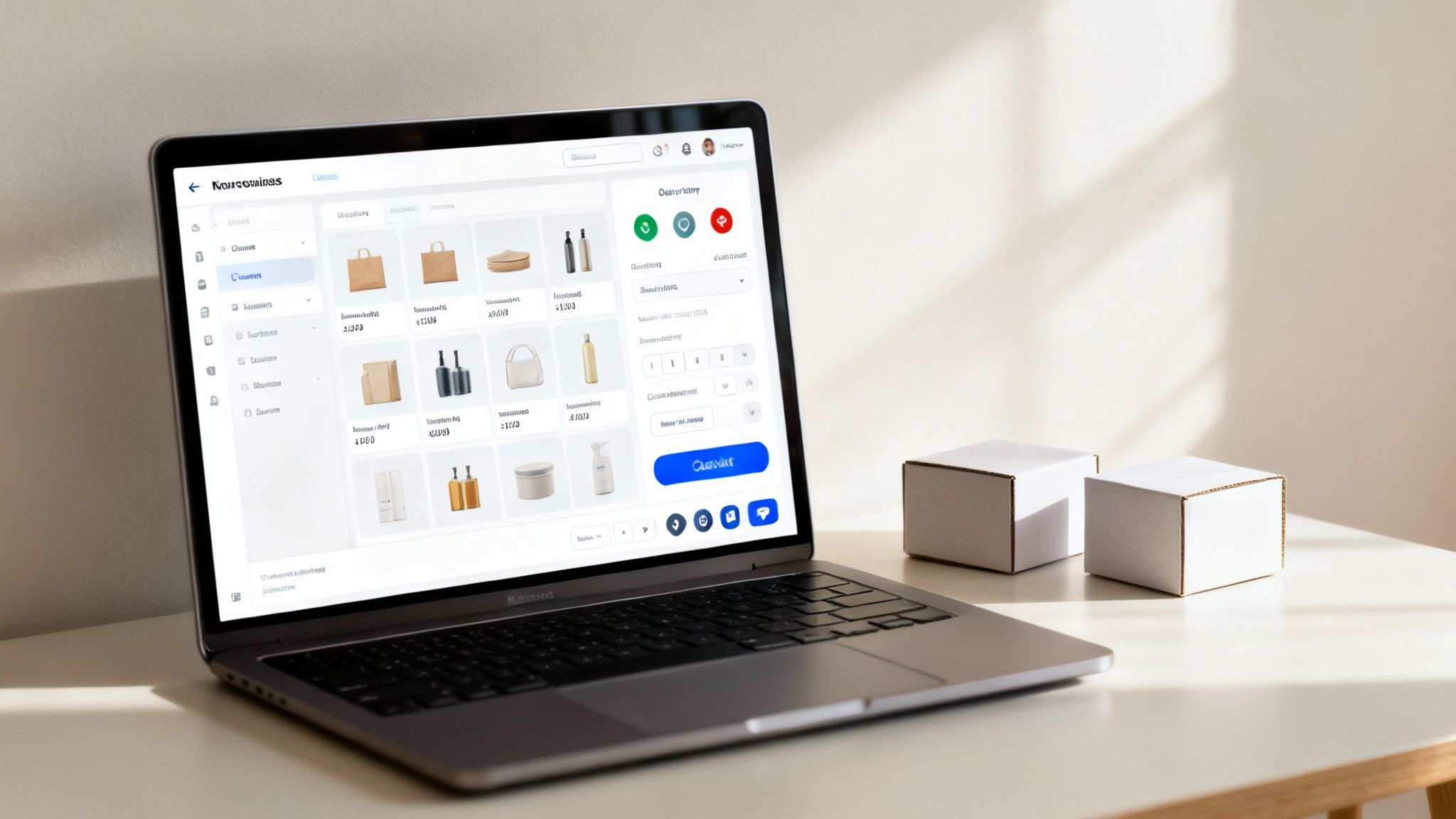
When you compare Wix and Shopify, their foundational differences are clear. Shopify was engineered as a commerce platform from the ground up, and that DNA is evident in every feature. Wix began as a website builder and integrated commerce tools later. The result is a system that works but lacks the depth ambitious brands require to accelerate growth.
This isn't a minor technical detail. It directly impacts your operational efficiency, conversion rates, and the risk of hitting a growth ceiling just as your brand gains momentum.
Product and Inventory Management
For a small store with a handful of products, either platform handles the basics. But for growth-stage brands, managing a complex and expanding catalog is a mission-critical function.
Shopify’s infrastructure is designed for this complexity. It effortlessly handles inventories with tens of thousands of SKUs, empowering you with granular control over product variants, multi-location stock tracking, and sophisticated collection management. This robust architecture ensures operations remain smooth, enabling you to manage a vast catalog without the friction that slows growth.
Wix provides more fundamental inventory tools better suited for simple product lines. While it covers essentials like variants and stock tracking, it becomes cumbersome as your catalog expands. The platform's hard limit of 50,000 products can become a significant roadblock for businesses with ambitious plans, forcing a costly and disruptive migration down the line.
Your product catalog is a living asset. The right platform enables you to manage its complexity with ease, transforming inventory management from a chore into a strategic advantage.
For merchants in Southeast Asia, this is especially critical. Brands in the region often manage diverse product lines for different local markets, which demands a system that can handle both nuance and scale. Shopify’s architecture is simply engineered for this reality.
Checkout Experience and Payment Processing
The checkout is where you convert interest into revenue. Any friction here directly impacts your bottom line.
Shopify has invested immense resources into creating one of the most optimized checkouts on the market. Its one-page checkout is built for speed and simplicity, minimizing the steps a customer takes to complete a purchase. Furthermore, Shopify Payments provides seamless integration and competitive transaction rates.
For businesses in Singapore, this is a game-changer. Shopify Payments includes native support for local payment methods like PayNow, removing a major point of friction for local shoppers and powerfully boosting conversion rates in the region.
Wix’s checkout process is functional but lacks Shopify's deep optimization. It relies more heavily on third-party payment gateways, which can create a disjointed customer experience and lead to higher transaction costs. Platforms differ greatly in how they empower merchants to track and improve their business. Understanding key ecommerce performance metrics is crucial for determining which platform’s toolkit will best ignite your financial goals.
Order Fulfilment and Logistics
Delivering orders to customers quickly and reliably is the final, critical piece of the e-commerce puzzle. This is another area where Shopify’s commerce-first DNA provides a decisive advantage.
Shopify’s ecosystem is built to integrate directly with a massive network of logistics and fulfillment partners. Its native features and vast App Store offer solutions for every part of the process:
- Shipping Profiles: Configure sophisticated shipping rules based on product type, weight, or destination.
- Carrier Integrations: Connect with major global and regional carriers for real-time shipping rates.
- Third-Party Logistics (3PL): Integrate effortlessly with fulfillment warehouses to automate your entire shipping operation.
While Wix offers basic tools for shipping, it lacks the advanced features and deep integration ecosystem that Shopify provides. For brands handling high order volumes or complex international shipping, Shopify’s infrastructure is simply better engineered to handle the load, ensuring your operations scale seamlessly with your sales.
Customisation Freedom and Developer Experience
Your brand’s vision is unique. Your e-commerce platform should be the tool that brings that vision to life, not the box that constrains it. For ambitious brands, customisation isn't about changing fonts; it’s about architecting a unique customer journey and integrating systems into a seamless operational backbone.
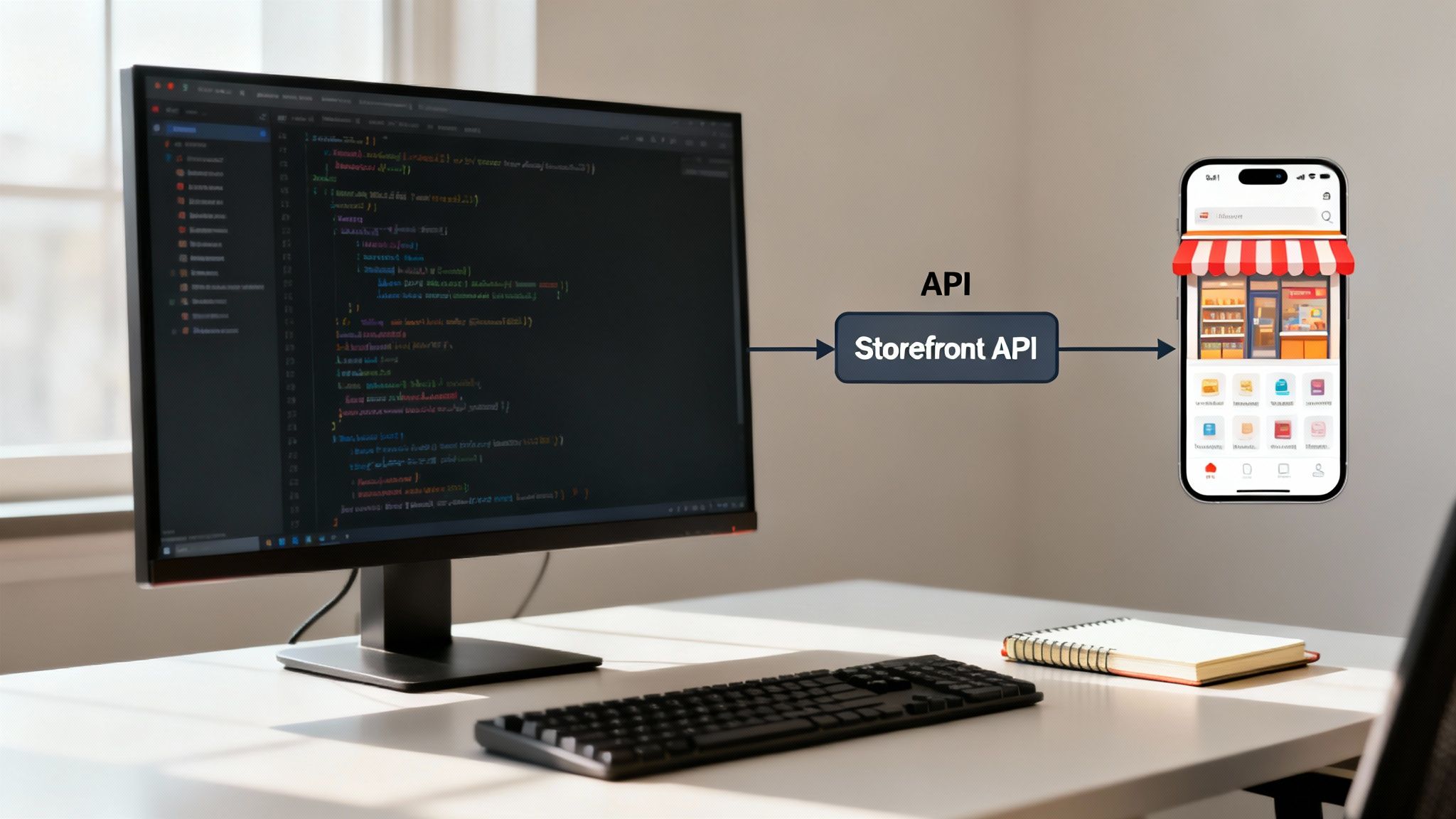
When you compare Wix and Shopify on this front, the difference in philosophy is stark. Shopify operates with an open, API-first mindset, giving developers the keys to build, extend, and innovate. Wix, while offering its own development environment, presents a more contained ecosystem with inherent limitations that can stifle true scalability.
This section moves past surface-level design tools to dissect the developer experience. We'll explore the practical implications for technical leaders, answering the critical questions: what are the real limits of customisation, and how deeply can the platform integrate with the rest of your tech stack?
The Core Development Environments
At the heart of any platform's developer experience are its core tools and languages. Shopify provides developers direct access to its powerful templating language, Liquid. This enables deep, granular control over the front-end theme structure, allowing for truly bespoke user interfaces that align perfectly with a brand’s identity. It achieves a balance of power and accessibility that developers value.
Wix’s approach is fundamentally different. It uses Velo, a JavaScript-based development platform. While Velo is capable of adding custom functionality within the Wix framework, it operates as a more closed environment. This means developers are working within the boundaries Wix has set, rather than having open access to the core architecture.
For a growth brand, architectural freedom is non-negotiable. The ability to connect, modify, and build upon your commerce platform's core is what unlocks competitive differentiation and long-term agility.
This distinction is crucial for any scaling business. With Shopify, you are modifying a flexible, open foundation. With Wix, you are adding features to a more rigid, predefined structure. The former is a catalyst for innovation; the latter can become a bottleneck.
API Access and System Integrations
Modern e-commerce is not an island. It’s a connected hub that must communicate seamlessly with critical business systems like your Enterprise Resource Planning (ERP), Customer Relationship Management (CRM), and Product Information Management (PIM) software. This is where the quality and breadth of a platform’s APIs become paramount.
Shopify’s entire ecosystem is built on a comprehensive suite of open APIs, providing developers with the hooks they need to integrate almost any external system. This robust API access is the very reason Shopify boasts the world's largest e-commerce app marketplace, with over 16,000 apps offering pre-built integrations for nearly any function imaginable.
Wix offers its own APIs through Velo, but they are less extensive and not as central to its platform architecture. Integrating with complex, legacy enterprise systems can be more challenging and often requires custom workarounds. When choosing between the two, technical leaders must consider not just today's integration needs, but the complex workflows they will inevitably require in the future.
Headless Commerce and Architectural Freedom
The ultimate expression of customisation is headless commerce. This architectural approach decouples the front-end presentation layer (the "head") from the back-end commerce engine. It allows brands to leverage Shopify’s powerful checkout, inventory, and payment processing while building an entirely bespoke front-end experience using any modern framework like React, Vue.js, or a custom mobile app.
Shopify actively enables this freedom with its Storefront API. It’s designed specifically for headless builds, giving developers the power to create truly unique, high-performance customer experiences without being tied to a traditional theme structure. This is the path enterprise-grade brands take to deliver unparalleled user journeys. Our comprehensive guide to Shopify Plus explores how top-tier brands embrace this future of B2B e-commerce.
Wix does not offer a comparable headless capability. Its architecture is monolithic, meaning the front-end and back-end are tightly coupled. This makes it a non-starter for brands that require the architectural flexibility and performance benefits of a headless implementation. For any business with a long-term vision that includes custom applications or content-rich experiences, Shopify's headless architecture is the only viable path forward.
Comparing Performance, SEO, and Global Scalability
For any ambitious brand, your digital presence must be fast, visible, and ready for global scale. Site performance, search engine optimisation (SEO), and international scalability are not just technical details; they are the pillars of sustainable growth. This is where the architectural differences between Wix and Shopify have a profound impact.
Shopify was engineered from the ground up for high-performance commerce. Its infrastructure is built on a world-class global Content Delivery Network (CDN), ensuring lightning-fast load times for customers, whether they're in Singapore or San Francisco. This resilient architecture is designed to handle massive traffic spikes and complex product catalogs without compromising speed.
Wix has made significant improvements to its SEO tools and site performance. However, its foundation as a website builder means its architecture is not fundamentally designed for the intense demands of high-volume, global e-commerce. For a brand poised to scale, that distinction is everything.
Performance is a feature, not an afterthought. In e-commerce, a one-second delay in page load time can result in a 7% reduction in conversions. The right platform builds speed into its very foundation.
Technical SEO and Search Visibility
Both platforms provide the essential tools for on-page SEO—editable title tags, meta descriptions, and custom URLs. They both generate sitemaps and allow for basic structured data. But for growth-focused brands, the conversation must go deeper into technical SEO.
Shopify’s commerce-first structure gives it a distinct advantage. Its clean, logical site architecture is inherently favored by search engines for indexing large product inventories. Key technical aspects are handled with greater precision:
- Canonical Tags: Shopify automatically manages canonical tags to prevent duplicate content issues—a common challenge for stores with many product variants.
-
Robots.txt Access: It provides direct access to the
robots.txtfile, giving your technical team granular control over how search engine crawlers interact with the site. - App Ecosystem: The Shopify App Store is filled with powerful, specialized SEO apps for advanced needs like image optimization, broken link detection, and complex schema markup.
Wix offers a solid SEO toolkit for content-heavy sites but can face challenges at scale. Its URL structure, while much improved, can still create complexities for advanced technical SEO management compared to Shopify's cleaner, commerce-focused architecture.
Global Scalability and Cross-Border Commerce
Expanding into new markets is a critical milestone for any growing brand. This demands a platform that not only allows international sales but actively simplifies the complex reality of cross-border commerce.
This is where Shopify truly accelerates ahead. Shopify Markets is a powerful, native solution designed to manage and optimize international selling from a single dashboard. It centralizes critical functions that would otherwise require a complex patchwork of third-party apps and manual processes.
With Shopify Markets, you can:
- Create localized shopping experiences with multiple currencies and languages.
- Manage international pricing strategies and duties collection.
- Customize domains and subdomains for specific regions to boost local SEO.
This integrated approach eliminates immense operational friction, empowering brands to test, launch, and scale in new regions with speed and confidence. For a deeper look, our guide on how Shopify powers multi-market growth details the strategic advantages.
Wix supports multiple currencies and offers tools for multilingual sites, but it lacks a unified, native solution like Shopify Markets. Managing international operations requires more manual setup and a reliance on various apps, adding complexity as your global footprint expands. For brands with serious international ambitions, Shopify’s architecture provides a much clearer, more scalable path forward.
Analysing the Total Cost of Ownership
The monthly subscription fee is just the beginning. The true cost of an e-commerce platform reveals itself as you scale. The strategic question isn’t about the initial price tag; it’s about whether the platform can fuel your growth without becoming a financial drag.
For any ambitious brand, understanding the Total Cost of Ownership (TCO) is essential. This is not about finding the cheapest option. It is about making a strategic investment that drives long-term profitability by analyzing transaction fees, essential app subscriptions, and future development needs.
Deconstructing Platform Fees and Transaction Costs
At first glance, Wix's entry-level plans appear more budget-friendly than Shopify's. But this initial saving quickly erodes when you factor in transaction fees. Wix relies on third-party payment processors, which typically charge around 2.9% + SGD 0.30 per transaction.
Shopify, however, provides a powerful incentive to use its integrated solution, Shopify Payments. By using it, brands on the main Shopify plan pay a lower rate of 2.0% + SGD 0.50 and—crucially—avoid the additional 1.0% transaction fee Shopify applies for using external gateways. As you process thousands of orders, this difference adds up to significant savings that flow directly to your gross margin.
The most expensive platform is the one that penalizes your growth. As your revenue climbs, transaction fee structures become a critical factor in your overall profitability.
That small percentage difference is a massive part of the TCO puzzle. For a business generating SGD 100,000 in monthly revenue, the gap in transaction fees alone can translate to thousands of dollars a year. As your sales volume increases, Shopify rapidly becomes the more cost-effective choice.
Factoring in the App Ecosystem
Both platforms require apps to extend their core functionality, but their cost structures and the strategic value they deliver are worlds apart. As you scale, you will need apps for advanced reviews, loyalty programs, subscription management, and marketing automation.
On Shopify, the app ecosystem is a mature, competitive marketplace. While premium apps have subscription costs, you are investing in powerful, specialized tools built to handle enterprise-level demands. This is not just a cost; it’s an investment that unlocks revenue-generating capabilities and operational efficiencies.
Wix’s app market is smaller and less focused on high-growth commerce. While you might find cheaper or free options for basic functions, you will likely need to patch together multiple apps to achieve what a single, robust Shopify app can deliver. This creates a tech stack that is not only more expensive but also less efficient to manage.
TCO Scenario for a Growth-Stage Brand
To put this into perspective, let's map out the likely monthly costs for a brand generating SGD 100,000 in revenue. This model includes platform fees, standard transaction rates, and a conservative budget for a suite of essential apps.
| Cost Component | Estimated Wix Cost (SGD) | Estimated Shopify Cost (SGD) |
|---|---|---|
| Platform Subscription | Business Plan ~ $50 | Shopify Plan ~ $110 |
| Transaction Fees | 2.9% + $0.30 on $100k ~ $2,900+ | 2.0% + $0.50 via Shopify Payments ~ $2,000+ |
| Essential App Suite | ~$150 - $250 | ~$200 - $350 |
| Estimated Monthly TCO | ~ $3,100 - $3,200 | ~ $2,310 - $2,460 |
This model reveals a clear financial tipping point. Even with a higher monthly subscription, Shopify's integrated payments and scalable architecture result in a significantly lower TCO as your business gains momentum.
This frees up capital to reinvest where it matters most: marketing, inventory, and talent. The choice between Wix vs Shopify is not just about technology; it's a strategic financial decision that will shape your ability to grow sustainably.
The Final Verdict: Choosing the Right Platform for Your Ambition
After dissecting the technical details, the decision comes down to a single, critical question: are you building a website that sells, or are you engineering a scalable retail business for the future?
It’s not about which platform is universally "better."
It’s about matching the architecture to your ambition.
For artists, service-based businesses, or entrepreneurs starting with a simple product catalog, Wix is a strong choice. Its power lies in its visual flexibility and intuitive editor, empowering anyone to create a beautiful site without code.
Defining Your Growth Trajectory
However, if your roadmap extends beyond the launch phase, the conversation shifts entirely.
For ambitious brands planning for serious growth—expanding product lines, launching in international markets, or building deep custom functionalities—the choice becomes clear. Shopify is the platform engineered for scale.
Its commerce-first foundation and limitless extensibility are built to handle complexity, not shy away from it. This is the resilient core you need to grow from a startup to a market leader without hitting a technical ceiling.
Your e-commerce platform should be a growth accelerant, not a future liability. The right choice empowers you to scale on your terms, unlocking new revenue streams and operational efficiencies as you grow.
This decision tree helps visualize the choice, focusing on your business model and the total cost of ownership as you scale.
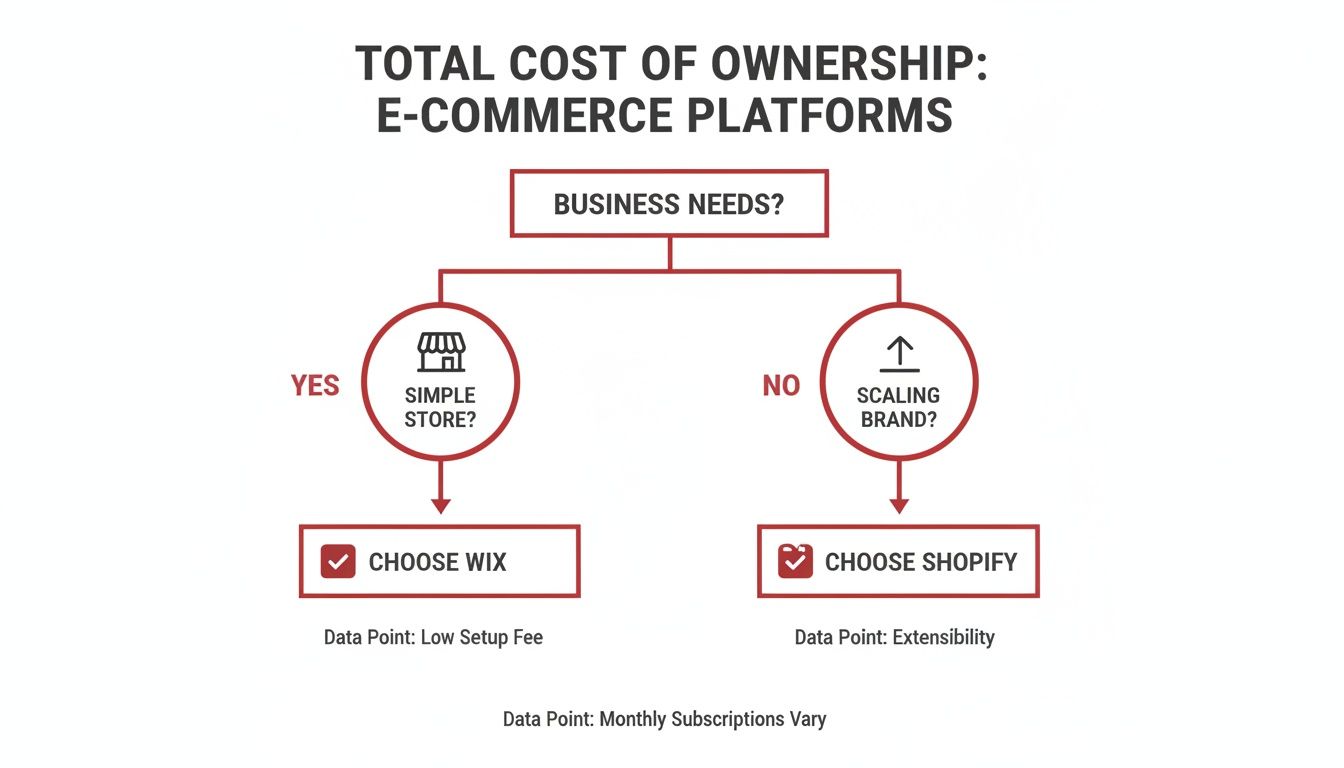
As the chart shows, while Wix might seem more cost-effective initially, Shopify delivers far greater long-term value for brands poised for growth in transaction volume and operational complexity.
Your Path Forward
Ultimately, this is a forward-looking investment in your brand’s potential. Choosing Wix means prioritizing immediate design simplicity. Choosing Shopify means committing to a future of unconstrained growth and the freedom to build a category-defining brand.
If you’re planning a platform change, resources on how to switch from Wix to Shopify can help guide your migration.
The right platform doesn’t just support your business today; it fuels what your business can become tomorrow. Choose the engine that can keep up with your ambition.
Frequently Asked Questions
When weighing Wix against Shopify, a few critical questions always arise. We've tackled the most common ones here to provide the clarity you need to make the right decision for your brand's future.
Which Platform Is Better For a Beginner?
If your primary goal is to launch a beautiful website quickly with light commerce features, Wix offers a more intuitive drag-and-drop editor. It is designed to simplify the design process for anyone without a technical background.
However, if you are a beginner who is serious about building a scalable retail business from day one, Shopify is the smarter choice. Its entire setup process is oriented around commerce, helping you build a much stronger foundation for growth, even if there's a slightly steeper learning curve initially.
Can You Migrate From Wix To Shopify Later?
Yes, you absolutely can. Moving from Wix to Shopify is a common path for brands that outgrow the limitations of Wix. The process involves exporting your data—products, customers, and orders—and importing it into your new Shopify store.
The real question isn’t if you can migrate, but when the cost of not migrating—in lost sales, operational friction, and missed opportunities—becomes too high. A planned migration is always better than a forced one.
While various tools and expert agencies can streamline the transition, it is not a simple copy-paste operation. A successful migration requires careful planning to protect your data, maintain SEO rankings, and redesign your storefront. This is precisely why it is more efficient to choose the platform that aligns with your long-term ambitions from the start.
Ready to build a high-performing e-commerce store that scales with your ambition? As Southeast Asia's only Shopify Platinum Partner, Jumpstart Commerce designs, builds, and grows elite Shopify experiences for the region's most ambitious brands. Let's build what's next, together.










Leave a comment
This site is protected by hCaptcha and the hCaptcha Privacy Policy and Terms of Service apply.