Running an eCommerce store, it's easy to get caught in the thrill of the next sale. A new order lands, you ship it out, and the hunt for the next customer begins.
But that cycle is a trap.
Moving Beyond the First Sale With Customer Lifetime Value
In a world where customer attention is the ultimate currency, fixating on single transactions is a strategy for stagnation. The key to building an enduring brand isn’t just making that first sale—it’s about unlocking the total value each customer brings over their entire relationship with you.
This is the power of Customer Lifetime Value (CLV).

Forget complex formulas for a moment. Think of CLV as a strategic lens for your business. It sharpens your focus, clarifying everything from your marketing spend to your product roadmap. It fundamentally reframes your objective.
Your goal is no longer just to make a sale. It is to build a relationship that generates predictable, long-term revenue.
Unlocking a New Strategic Perspective
Once you start thinking in terms of CLV, you naturally shift from a reactive, sale-by-sale mindset to a proactive, relationship-focused one. It’s the difference between sprinting for a quick win and training for a marathon. This perspective immediately gives you an edge:
- Smarter Acquisition Spending: You know precisely what a customer is worth. This empowers you to confidently invest more to acquire the right kind of customer, knowing the long-term ROI will far outweigh the initial cost.
- Enhanced Retention Focus: CLV makes it crystal clear that retaining an existing customer is exponentially more profitable than finding a new one. This insight justifies investment in exceptional service, loyalty programs, and community building.
- Informed Product Development: By analyzing your highest-CLV customers, you uncover exactly which products resonate. This data provides a clear roadmap for innovation and inventory decisions.
- Accelerated Profitability: A focus on CLV is a direct path to a healthier bottom line. It’s a system designed to encourage repeat purchases and build lasting customer loyalty.
CLV as a Growth Catalyst
For any ambitious brand, especially on a platform like Shopify, CLV is more than just a metric—it's a growth catalyst. If you’re just getting started, getting a handle on the platform basics is a great first step. Our guide on what Shopify is can get you up to speed.
Ultimately, CLV cuts through the noise. It provides the clarity to stop chasing one-off sales and start building a reliable engine for growth. To dig deeper into the concept, you can explore more about Customer Lifetime Value and its core ideas. It’s time to focus on the relationships that truly fuel your business.
Why CLV Is Your Ultimate eCommerce Growth Metric
Too many brands are stuck on an expensive treadmill, desperately chasing new customers just to stay afloat. But this constant hunt for the next sale isn't a growth strategy—it's a survival tactic. The real path to building a profitable, enduring brand is to shift your focus from the first purchase to the entire customer lifecycle.
This is where Customer Lifetime Value (CLV) ignites progress. It’s more than just another number on your dashboard; it's the north star for your entire growth plan. CLV forces you to ask a better question: not "How do we make this sale?" but "How do we build a relationship that keeps delivering value for years to come?"
Putting CLV first is what separates brands that just get by from those that dominate their categories.
Escaping the Customer Acquisition Trap
Relying solely on new customer acquisition is a dangerous game, especially in a dynamic market like Southeast Asia. For brands here in Singapore, moving from a pure acquisition mindset to one focused on maximizing customer lifetime value is no longer an option. It’s essential for survival.
The numbers confirm it. Prioritizing CLV boosts long-term profitability by 23% for regional brands. That’s a critical advantage when customer acquisition costs (CAC) have not only tripled since 2013 but skyrocketed by over 50% in the last five years alone. In a market where relationships matter, eCommerce leaders like Jumpstart Commerce are helping merchants fight back with AI-powered journey audits and smart loyalty systems. When you’re losing an average of $29 for every new customer you acquire, short-term thinking is a luxury you can't afford. Find out how Southeast Asian sellers can fight back against rising acquisition costs by reading the full analysis.
Fueling Smarter, More Profitable Growth
Once you know what a customer is truly worth to your business over time, everything changes. It delivers a new level of clarity, empowering you to make confident decisions that go straight to your bottom line.
CLV turns your marketing from a cost center into a strategic investment engine. When you know a customer segment's lifetime value, you can confidently invest more to acquire them, knowing the long-term payoff justifies the upfront cost.
This insight fundamentally reshapes your approach to growth. Suddenly, you can:
- Optimize Your Marketing Spend: Stop spreading your budget thin. Instead, go all-in on the channels that attract high-value customers, even if their initial acquisition cost is higher.
- Improve Unit Economics: By retaining customers longer, you extract more revenue from each one. This directly strengthens your profitability and makes your business far more resilient.
- Build a Sustainable Growth Loop: High-CLV customers don't just buy more; they become your most powerful advocates. They purchase more often, spend more per transaction, and create word-of-mouth momentum, fueling a self-sustaining cycle of growth.
The Foundation of a Resilient Brand
In a crowded marketplace, the brands that last are the ones that build real relationships. A high CLV is a direct indicator of a healthy, customer-centric business that people love coming back to. It’s proof of strong product-market fit, excellent service, and a brand experience that creates genuine loyalty.
Making this metric a priority isn’t just an option for ambitious brands anymore.
It’s the central pillar of a modern, winning commerce strategy. It’s how you graduate from chasing one-off sales to building an enduring, valuable business.
How to Calculate Customer Lifetime Value Accurately
Knowing CLV is a game-changer is one thing; calculating it is where strategy meets action. The good news? You don’t need a data science degree to get started.
The key is to begin with a simple model, build confidence, then advance to more sophisticated methods as your business scales. Let's break down the three main ways to calculate CLV, moving from a quick snapshot to a much sharper, predictive picture.
This diagram shows how CLV acts as the central hub for sustainable growth, branching out into profitability and business resilience.
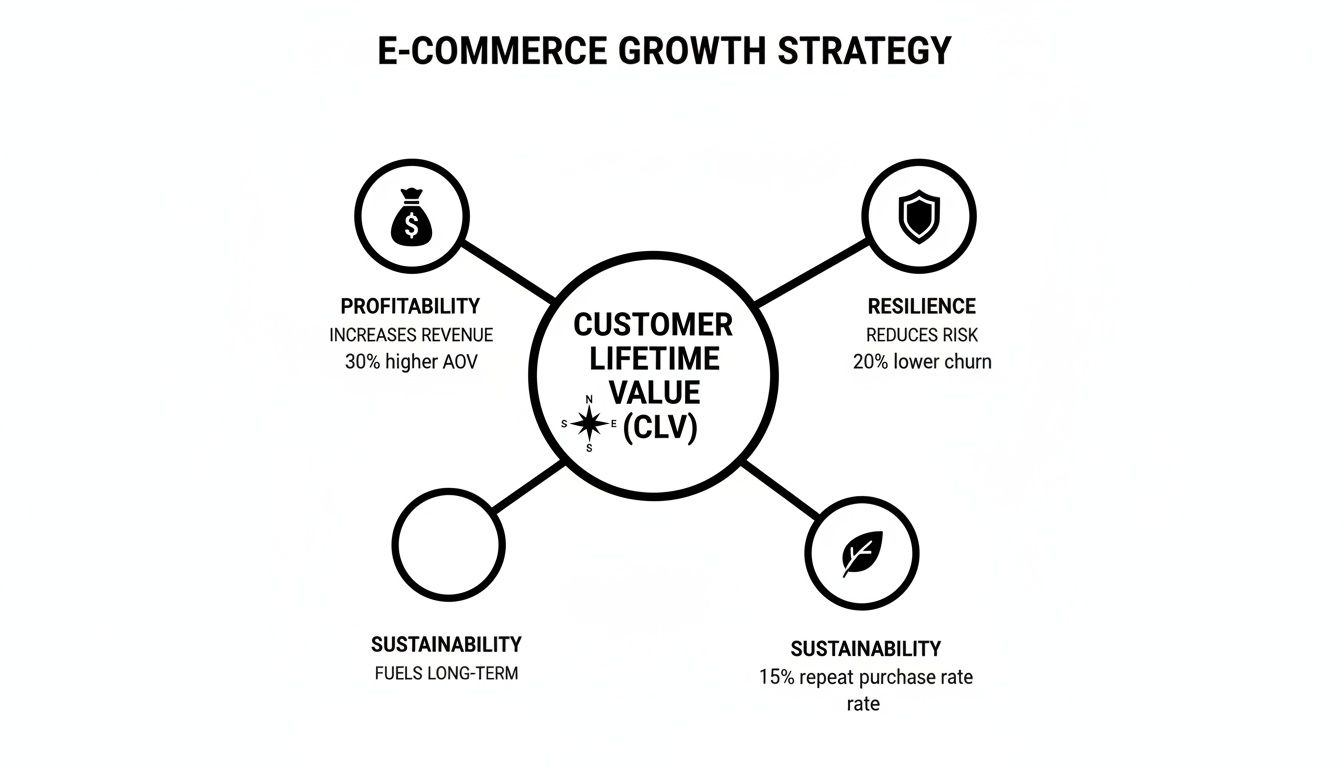
As you can see, a high CLV isn't just another metric. It's the foundation for a business that can weather market shifts and drive consistent profit.
The Simple CLV Formula: Your Starting Point
This is the fastest way to get a baseline read on your CLV. It’s perfect for new brands or for a quick health check, giving you a historical view of your average customer's worth.
Here’s how it works:
- Average Purchase Value (APV): The average amount a customer spends in a single order. Divide your total revenue over a period by the total number of orders in that same timeframe.
- Average Purchase Frequency Rate (APFR): How often a customer buys from you. Calculate it by dividing the total number of orders by the total number of unique customers over that period.
- Customer Value (CV): Multiply the two metrics above (APV x APFR). This reveals the average annual value of a customer.
- Average Customer Lifespan (ACL): The average time a customer remains active before they churn. A simple estimate (e.g., 1-3 years) works perfectly for this model.
- Simple CLV: Finally, multiply Customer Value by the Average Customer Lifespan (CV x ACL).
Formula: (Average Purchase Value x Average Purchase Frequency Rate) x Average Customer Lifespan = Simple CLV
While this formula is a fantastic starting point, its main limitation is that it averages everyone together. It misses the critical insight that some customers are far more valuable than others.
Cohort Analysis: A More Granular View
This is where your insights get sharper. A cohort analysis groups customers based on when they made their first purchase (e.g., all customers from January 2023). Tracking these groups over time reveals exactly how their spending habits evolve.
This method moves beyond simple averages to uncover powerful trends.
You might discover that customers acquired during a Black Friday sale have a much lower CLV than those who found you in May. This insight is pure gold. It signals that your holiday shoppers are discount-driven, while your May customers are true brand fans.
With this knowledge, you can:
- Refine Marketing Spend: Shift your budget toward campaigns that attract those high-value cohorts.
- Improve Onboarding: Create specific welcome journeys for different cohorts to ignite that crucial second purchase.
- Measure Strategic Impact: See precisely how a new loyalty program or shipping policy affected the CLV of new customer groups.
You can run a basic cohort analysis right inside Shopify Analytics or use more advanced tools for deeper segmentation. The goal is to stop seeing your customer base as one uniform group and start recognizing the distinct segments within it.
Predictive CLV: Looking to the Future
Predictive CLV is the most advanced approach. Instead of only looking at past behavior, it uses data modeling to forecast how much revenue a customer is likely to generate in the future.
This model analyzes signals like:
- Time between purchases
- Products viewed or added to cart
- Engagement with marketing emails
- Use of discount codes
By spotting patterns, predictive models can assign a future value score to customers with impressive accuracy. This allows you to be proactive, not reactive.
Imagine knowing which of your newest customers have the highest potential to become VIPs. You could roll out the red carpet with exclusive offers, personalized content, and exceptional service to lock in their loyalty from day one.
Predictive CLV shifts your strategy from reacting to the past to actively shaping the future. It’s about identifying your next best customer and nurturing that relationship before they even consider leaving.
While this requires more sophisticated tools—often found in dedicated CRMs or customer data platforms—the return is immense. It unlocks true one-to-one marketing at scale, ensuring you invest your resources where they’ll deliver the greatest long-term results.
Three Methods for Calculating CLV
Here's a quick comparison of the different ways to calculate CLV, helping you choose the right one for your current needs.
| Method | Formula / Approach | Best For | Pros | Cons |
|---|---|---|---|---|
| Simple CLV | (APV x APFR) x ACL | Early-stage businesses or a quick health check. | Fast and easy to calculate with basic data. | Relies on averages; ignores customer segmentation. |
| Cohort Analysis | Grouping customers by acquisition date and tracking their cumulative spending over time. | Growing businesses wanting to understand customer behaviour trends. | Identifies high-value customer groups and measures the impact of marketing changes. | Requires more data and can be complex to set up. |
| Predictive CLV | Using machine learning models to forecast future customer spending based on historical and behavioural data. | Mature businesses looking to optimise marketing spend and personalise at scale. | Highly accurate and forward-looking, enabling proactive strategies. | Requires advanced tools and significant data volume. |
Starting with the simple formula builds the foundation, but aiming for predictive insights is what truly unlocks exponential growth.
Actionable Strategies to Accelerate Your CLV
Knowing your Customer Lifetime Value is one thing. Activating that insight is where real growth ignites.
Calculating CLV is the diagnosis; now it's time for action. The goal isn't just to make small tweaks but to systematically elevate the value each customer brings to your business. We'll do this by focusing on four core pillars: retention, loyalty, personalization, and smarter acquisition.
These aren't just concepts. They are the levers you pull to transform one-off transactions into long-term, profitable relationships.
Ignite Retention with Exceptional Post-Purchase Experiences
Too many brands drop the ball the moment a customer clicks "buy." The sale isn't the finish line—it's the starting pistol for building a lasting relationship. A stellar post-purchase experience is what separates a one-time buyer from a lifelong fan.
Forget the generic confirmation email. You need to create a seamless journey that adds value and reassures them they made the right choice. This is where you lay the groundwork for their next purchase.
Here’s how to do it:
- Proactive Communication: Don't make customers hunt for information. Deliver it before they even think to ask. Branded order tracking pages and timely shipping updates demonstrate control and care.
- Make the Unboxing an Event: The delivery is your chance to make a physical impression. Thoughtful packaging, a handwritten note, or a small, unexpected gift creates a memorable moment that customers will want to share.
- Effortless Returns: Nothing kills future business faster than a complicated returns process. Make it fast, free, and painless. Turning a potential negative into a trust-building moment is a massive win.
A smooth, reassuring post-purchase flow doesn't just reduce support tickets—it builds the confidence that brings customers back.
Build a Loyalty Programme That Drives Real Value
A loyalty program should be more than a glorified discount card. Designed correctly, it becomes a powerful engine for increasing both purchase frequency and average spend. A great program makes your best customers feel seen, valued, and rewarded for their commitment.
In Singapore's bustling eCommerce scene, loyalty is a massive opportunity. The market is projected to hit US$589.7 million after growing at 11.8% annually from 2019 to 2023. For ambitious Shopify merchants—like those who partner with Jumpstart Commerce, the region's only Platinum Partner—this is an opportunity you can't ignore. In fact, research shows that 70% of consumers spend more with brands after joining their loyalty programs. That’s a direct boost to your CLV.
A loyalty program shouldn’t just reward spending. It should reward engagement, turning customers into advocates who feel like insiders.
To build a system that truly moves the needle, think beyond simple points-for-dollars. Implement a tiered structure where customers unlock exclusive perks—like early access to sales, free shipping, or special events—as they spend more. This gamifies the experience and gives them a clear incentive to choose you over a competitor.
Leverage Personalisation to Create Deeper Connections
Today’s shoppers expect personalization. The days of one-size-fits-all marketing are over. To maximize CLV, you must deliver relevant, timely, and individual experiences at every touchpoint.
This is where your data becomes your most valuable asset. By analyzing purchase history, browsing habits, and email engagement, you can craft customer journeys that truly resonate. Personalization isn't about being invasive; it's about showing your customers you understand them.
Here are a few ways to put this into practice:
- Targeted Email and SMS Flows: Go beyond the generic newsletter. Use segmentation to send abandoned cart reminders, post-purchase tips, and product recommendations that are directly relevant to their past behavior.
- Dynamic On-Site Content: Customize your storefront for returning visitors. Show them products related to their last purchase or highlight categories you know they're interested in.
- Personalised Offers: Instead of site-wide discounts, send tailored offers to specific segments. A VIP customer might get an exclusive early-bird discount, while a new customer could get a special welcome offer to secure their second purchase.
These tactics show your customers they're more than just an order number. For a closer look at practical methods, check out this guide on how to increase customer lifetime value.
Optimise Acquisition for High-Potential Customers
Finally, boosting CLV starts before you even make the first sale. It begins with attracting the right kind of customer. Too many brands get fixated on a low cost-per-acquisition (CPA), but that’s a dangerously short-sighted metric.
A low CPA is worthless if those customers buy once and never return.
The real goal is to shift your focus from acquisition cost to acquisition value. Use your existing CLV data to identify which channels and campaigns deliver customers with the highest long-term potential. Then, double down on those sources, even if their initial CPA is higher. This strategic shift transforms your marketing spend into a true growth investment, fueling a cycle of profitable, sustainable expansion. You can learn more about how marketing automation is revolutionising eCommerce growth right here in our guide.
Using Personalization to Maximize Customer Value

Generic, one-size-fits-all marketing no longer works. To truly boost your Customer Lifetime Value, you must shift from broadcasting one message to everyone and start creating tailored, one-to-one conversations that make each customer feel understood.
Personalization is the single most powerful tool for influencing loyalty and spending habits. It transforms casual shoppers into dedicated brand fans by delivering experiences that feel uniquely crafted for them.
This goes far beyond just using a first name in an email. It’s about using real customer data—like purchase history and browsing activity—to create a journey that anticipates their needs before they even articulate them.
From Data to Deeper Relationships
Every click, purchase, and interaction a customer has with your store is a signal. Your job is to assemble these signals to build a more relevant and compelling experience.
The best brands are already doing this. They analyze data to offer hyper-relevant product recommendations, set up intelligent email flows, and customize on-site experiences. The result? A shopping journey that feels less like a sales pitch and more like a helpful conversation.
When you get this right, personalization isn't just a feature; it becomes the bedrock of a modern, high-growth retention strategy.
Personalization is no longer a feature; it is the core of a customer-centric business model. It proves you're paying attention, which is the ultimate form of customer service.
This approach directly fuels the metrics that drive up CLV: it encourages higher purchase frequency, increases average order value, and extends the customer lifespan.
The Impact of Hyper-Personalization
In Singapore and across Southeast Asia, personalization is the key to unlocking higher customer lifetime value. We're already seeing financial institutions in the region achieve incredible results, hitting up to 35% customer engagement rates and 17% sales conversions just by using transactional data smartly. For eCommerce brands working with Jumpstart Commerce, this success can be replicated by deploying AI-driven CRO audits and custom apps.
This strategy builds deeper relationships in a market where consumers are spending more carefully but are hungry for genuine value. UOB’s rollout of 171 personalized insights, for example, sent engagement soaring by 400%, proving just how powerful hyper-personalization can be for boosting CLV. You can find more insights on how personalised engagement drives business impact in Southeast Asia.
Activating Your Personalization Strategy
Putting personalization into practice doesn't require a complete overhaul of your marketing. You can start with a few targeted, high-impact tactics that deliver immediate results and build from there.
Here’s how you can get started:
- Segmented Email and SMS Campaigns: Stop sending the same newsletter to everyone. Group customers by purchase history or engagement levels and send them content that matters. A "we miss you" campaign with a tailored offer for lapsed customers is a simple, powerful way to reactivate them.
- Dynamic Product Recommendations: Use a customer's browsing and purchase data to power "You might also like" sections on your product pages and in post-purchase emails. This improves their experience and naturally increases your average order value.
- Customized On-Site Experiences: Greet returning customers with a personalized welcome message or showcase recently viewed items on the homepage. Small touches like these demonstrate that you remember them and value their business, making your storefront far more engaging.
These actions are the first steps toward building a powerful personalization engine. To see how tools like Klaviyo can help you create these kinds of automated, revenue-driving flows, discover how you can unlock free-flowing cash with smart automation.
By truly embracing personalization, you move from just selling products to building relationships. That’s the secret to creating a loyal customer base that not only buys from you again and again but also becomes your biggest advocate.
Got Questions About CLV? We’ve Got Answers.
Diving into Customer Lifetime Value is a journey. Like any major strategic shift, it’s bound to raise questions. Gaining clarity on the details is what transforms this metric from a buzzword into a true engine for growth.
Here, we’ll tackle some of the most common questions we hear from brands as they start putting CLV at the center of their strategy. These answers will help you get practical with using CLV to build a more resilient and profitable business.
What’s a Good Customer Lifetime Value to CAC Ratio?
A healthy CLV to Customer Acquisition Cost (CAC) ratio is one of the most vital signs of a sustainable business. It answers a simple but critical question: are you generating more from your customers than you’re spending to acquire them?
The gold standard is a 3:1 ratio. This means for every dollar you spend to acquire a customer, you generate three dollars back over their lifetime. It’s the sweet spot that signals strong profitability and provides the cash flow needed to reinvest in growth.
What do other ratios signal?
- 1:1 Ratio: You’re breaking even on every new customer. This is a precarious position, leaving no margin for error or investment.
- Below 1:1: This is a red flag. You're losing money on every customer you bring in. This model is unsustainable and requires an immediate strategic rethink.
- Above 3:1: A ratio of 4:1 or 5:1 points to an incredibly efficient growth engine. In fact, it might be a sign that you can be more aggressive with your marketing spend to accelerate growth.
Keeping a close eye on this ratio is fundamental to optimizing your marketing budget and building a brand that lasts.
How Often Should We Calculate and Review Our CLV?
CLV isn’t a "set it and forget it" metric. It’s a living number that reflects the health of your customer relationships. Because of this, it needs to be reviewed in a rhythm that makes sense for your business.
For most established eCommerce brands, a quarterly review is the sweet spot. It’s frequent enough to spot meaningful trends and measure the impact of your strategies, but not so frequent that you’re overreacting to short-term fluctuations.
However, if your business is moving at a faster pace, you’ll want to check in more often.
For fast-growing brands or those that have just rolled out a major retention initiative—like a new loyalty program or a personalization engine—a monthly review delivers the timely insights you need to make quick, data-informed adjustments.
The key, no matter the frequency, is consistency. Regular, scheduled tracking is what allows you to draw a clear line between the actions you take and the value your customers bring back to your business over time.
Which Shopify Tools Can Help Me Track CLV?
The Shopify ecosystem is packed with tools that take the headache out of tracking and improving CLV. They transform it from a manual spreadsheet exercise into an automated insight machine.
You have a mix of powerful native features and a whole App Store full of specialized solutions.
-
Native Shopify Analytics: Right inside your Shopify dashboard, you have incredibly useful reporting tools. The customer cohort analysis report is the perfect place to start. It lets you group customers by acquisition date and track their spending over time, offering a fantastic first step for understanding the value of different customer groups.
-
Specialised Shopify Apps: When you’re ready for deeper, automated insights, the Shopify App Store is your best friend. Tools like Lifetimely, Glew.io, or Triple Whale are purpose-built for this. They offer dedicated dashboards that automatically calculate CLV, segment your customers by value, and track other mission-critical retention metrics.
These apps plug directly into your store’s data, turning raw numbers into a clear, actionable picture of your customer value. They free you from spreadsheets so you can focus your energy on what truly matters: accelerating growth.
Ready to stop chasing one-off sales and start building an engine for long-term, profitable growth? At Jumpstart Commerce, we help ambitious brands design, build, and scale high-performing Shopify stores powered by data-driven retention and loyalty systems. Let's build your future, together.
Article created using Outrank







Leave a comment
This site is protected by hCaptcha and the hCaptcha Privacy Policy and Terms of Service apply.