

Starting an ecommerce business is no longer about just launching a website. It’s about building a brand engineered to last. The entire journey accelerates around a few critical moments: achieving total clarity on your market, building your digital flagship on a platform like Shopify, engineering an unbeatable customer experience, and igniting a growth engine from day one. This guide is your blueprint for building a brand that wins.
The New Blueprint for Ecommerce Success in SEA
Forget the old playbook of launching a store and hoping for traffic. To win in ecommerce today, you need a new blueprint—one built around intelligent growth, brand resilience, and a deep understanding of your customer. Think of it less as a rigid checklist and more as a series of strategic moves designed to build unstoppable momentum.
This shift in mindset is critical in Southeast Asia (SEA), a region supercharged with digitally native shoppers and explosive growth potential.
Why Southeast Asia Is Your Launchpad
The opportunity here is undeniable. Singapore's e-commerce market is expanding at an incredible velocity. In 2024, the market generated a gross merchandise volume (GMV) of US$8.2 billion, a figure set to ignite to US$11 billion by 2025.
That’s a compound annual growth rate (CAGR) of 8.8% through 2028. What’s catalysing this? Singapore's staggering 96% internet penetration rate and 3.51 million active e-commerce shoppers. These aren't just numbers; they are a clear signal of a massive, engaged audience ready for ambitious brands to lead the way.
This infographic paints a clear picture of the momentum across the region.
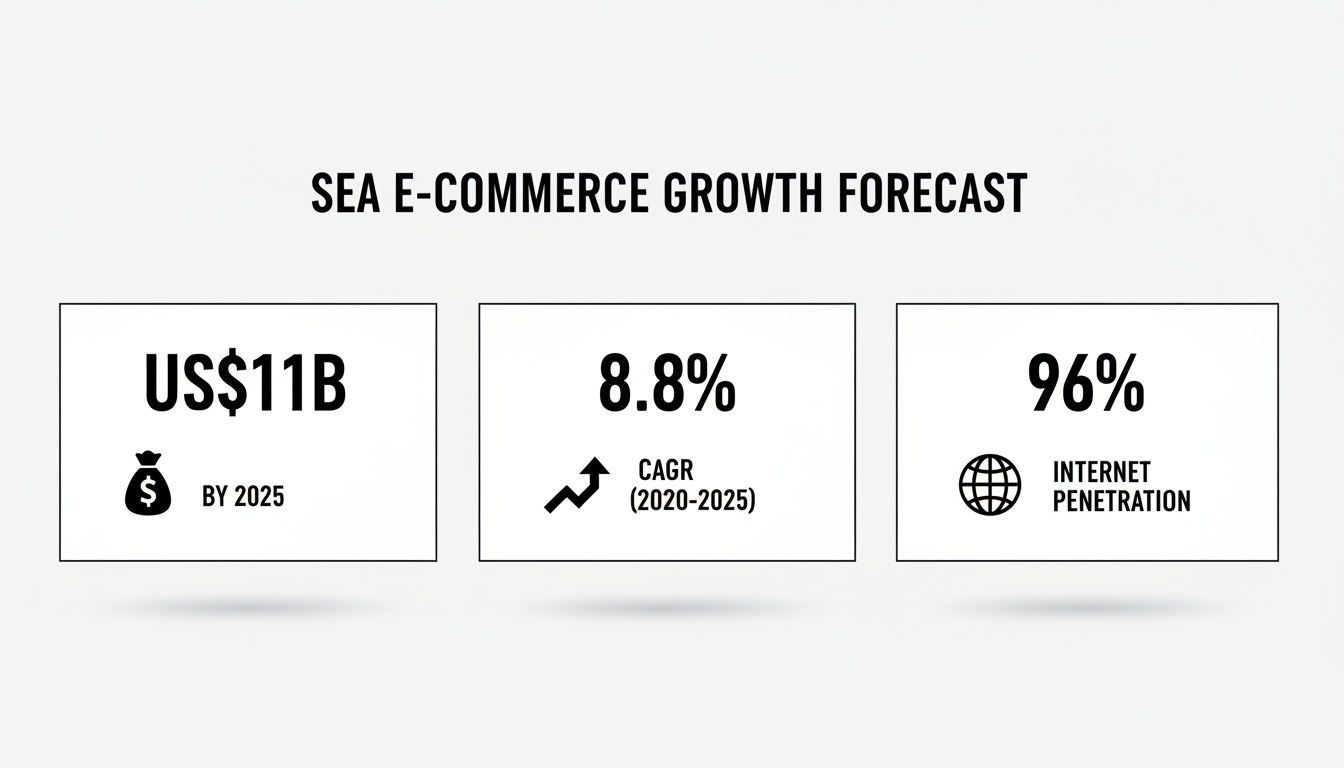
These figures prove the foundation for digital commerce in SEA isn't just solid—it's accelerating.
A Strategic Framework for Modern Founders
This guide is your strategic partner, not just an instruction manual. We are framing the process of starting an ecommerce business as a series of critical choices that empower you to build a brand with lasting impact.
The goal is to shift from a simple checklist mindset to a growth engine mentality. It’s about designing a business that not only launches strong but is built from the ground up to adapt, scale, and thrive in a dynamic market.
We’ll walk through everything from the fundamentals of market research to the advanced strategies for scaling, all calibrated for the unique landscape of Southeast Asia. Each section is packed with actionable insights to give you the confidence to execute flawlessly. And to ensure all your foundational bases are covered, an ultimate business startup checklist is an indispensable tool.
Let's begin building your digital flagship.
Defining Your Product and Market Strategy
Every powerful ecommerce brand is built on a rock-solid strategy, not just a good idea. Before you think about sourcing or website design, the most ambitious founders achieve total clarity on three things: what they sell, who they sell it to, and why anyone should care. This isn't just about finding a "niche"; it's about identifying a real market opportunity and building a brand that's difficult to replicate.
This foundational work creates momentum and ensures the business you build is profitable, scalable, and resilient from day one.

Uncovering a High-Potential Market Gap
The Southeast Asian market is buzzing with opportunity, but it’s also crowded. To succeed, you must pinpoint an underserved audience or an unmet need with laser precision. Forget trying to appeal to everyone; your goal is to find a specific segment you can completely own.
Start by mapping the landscape. Use tools like Google Trends to track search behaviour over time in countries like Singapore, Malaysia, or the Philippines. Go deeper by exploring online forums, subreddits, and Facebook groups where your potential customers converge. Pay close attention to their frustrations, what they wish they could find, and the exact language they use. These are direct clues to market gaps.
This isn’t about chasing a fleeting trend. It's about finding a passionate audience with a problem that current players are not solving effectively.
Crafting a Compelling Value Proposition
Once you’ve identified that gap, your next move is to define exactly how your brand will fill it. This is your unique value proposition (UVP)—a clear, powerful statement explaining the distinct benefit you offer. It directly answers the customer's core question: "Why should I buy from you and not the competition?"
Your UVP must be more than a clever slogan. It is the North Star for your product decisions, branding, and the entire customer journey.
Here are several angles to build a powerful UVP:
- Product Superiority: Do you leverage better materials, have game-changing features, or offer a solution that simply performs better?
- Exceptional Service: Can you deliver a level of support, personalisation, or a seamless experience that competitors overlook?
- Ethical Sourcing: Does your brand stand for something that matters, like sustainability, fair trade, or a social cause your audience deeply values?
- Curation and Expertise: Are you the definitive expert in your niche, offering a perfectly curated selection that eliminates decision fatigue for customers?
Your value proposition is your promise to the customer. It’s the core reason your brand deserves to exist and the anchor for every decision you make as you learn how to start an ecommerce business.
To systematically evaluate your ideas, use this framework to compare potential niches.
Strategic Niche Analysis Framework for SEA
Use this framework to evaluate potential ecommerce niches based on key success factors in the Southeast Asian market.
| Evaluation Criteria | High-Potential Indicator | Low-Potential Indicator |
|---|---|---|
| Audience Passion | Active online communities, forums, and social media groups exist. | Low search volume, little online discussion, hard to find target audience. |
| Market Size | A large enough addressable market to be profitable, but not so big it's saturated. | Extremely niche with a tiny customer base or dominated by a few massive players. |
| Problem Severity | The product solves a significant pain point or fulfils a strong desire. | Product is a "nice-to-have" with no real urgency or strong emotional pull. |
| Profit Margin | Healthy margins after COGS, shipping, and marketing are accounted for. | Razor-thin margins requiring huge volume to be profitable; high shipping costs. |
| Competitive Landscape | Some competitors exist (validating the market), but there's a clear gap in their offering. | Saturated market with many established brands or no competitors at all (red flag). |
| Sourcing Viability | Reliable suppliers or manufacturers are accessible within the region or globally. | Difficult to find quality suppliers; high minimum order quantities (MOQs). |
A strong niche will check most of the "High-Potential" boxes, giving you a clear path forward.
Mapping Your Financial and Sourcing Strategy
A brilliant idea is powerless without a viable financial model. You need a clear path to profitability from the start. This means getting intimately familiar with your numbers long before you make your first sale.
Start by calculating your Cost of Goods Sold (COGS), which includes everything from manufacturing to shipping from your supplier. Then, project your operational costs—platform fees, marketing budget, and salaries. This is how you set a pricing strategy that generates profit on every sale.
Your sourcing strategy is directly linked to this financial plan. Whether you partner with a local manufacturer, a dropshipper, or a wholesaler, that choice impacts your costs, quality control, and brand promise. A premium brand promising top-tier quality cannot use the cheapest supplier if it means a subpar product. Your sourcing must reinforce your value proposition, not undermine it. To go deeper, learn more about the strategic benefits of moving beyond marketplaces to build a powerful direct-to-consumer brand.
This foundational work—finding a real market gap, defining your unique value, and mapping a profitable financial path—is what separates temporary online stores from enduring brands.
Building Your Digital Flagship on Shopify
Your ecommerce store is far more than a product listing. It is your digital flagship—the definitive online space where customers connect with your brand and what it stands for. Choosing the right platform isn't just a technical task; it's a strategic decision that dictates how fast and how far you can scale. For ambitious brands in Southeast Asia poised for growth, Shopify is the engine.
The right commerce architecture simplifies complexity. It empowers you to build for what's next without being held back by technical debt. Let's enter the build phase with a clear plan, focused on creating a solid foundation that will support your vision for years to come.
Selecting a Theme That Converts
Your Shopify theme is the visual architecture of your store. It sets the tone for your brand aesthetic, but more importantly, it defines the fundamental user experience. The objective is to select a theme that not only reflects your brand's identity but is also ruthlessly optimised for conversions.
Look beyond colours and fonts. A high-performing theme must deliver on several non-negotiables:
- Mobile-First Design: A huge portion of SEA's traffic shops on mobile. Your site must look and feel flawless on a small screen. This is non-negotiable.
- Fast Loading Speeds: Every millisecond counts. Slow pages are the leading killer of sales and a primary cause of abandoned carts. Prioritise themes known for speed.
- Intuitive Navigation: A great theme makes it incredibly easy for customers to find what they're looking for, guiding them from discovery to checkout without a moment of confusion.
The Shopify Theme Store is an excellent starting point. You can filter by industry, catalogue size, and essential features like quick-buy buttons or promotional banners. While premium themes come at a cost, they often pay for themselves with more robust features and dedicated support—a smart investment for any serious brand.
Structuring Your Product Catalogue
An organised product catalogue is the difference between a seamless customer journey and a frustrating one. Get it wrong, and you lose sales before customers even find what they need. Your mission is to create a logical hierarchy that makes browsing feel intuitive and effortless.
Start by mapping your product categories and subcategories. For example, a fashion brand might structure its catalogue like this:
- Main Category: Women
- Subcategories: Dresses, Tops, Bottoms, Outerwear
- Filters: Size, Colour, Material, Price
This logical flow enables customers to drill down to find exactly what they need without feeling overwhelmed. Always use clear, descriptive names for your categories and avoid internal jargon. Remember, this structure is only as good as your product presentation—high-quality photography and compelling descriptions are what ultimately drive the conversion.
Your product page is your digital salesperson. It must answer every potential question, showcase the product's value, and make the path to "Add to Cart" irresistible.
Configuring for the Southeast Asian Market
Operating in Southeast Asia means thinking local from day one. A generic, one-size-fits-all setup will instantly alienate regional customers and create friction where you can least afford it. Configuring your store for local markets is a powerful move that builds trust and dramatically boosts conversion rates.
Focus on these critical configurations right from the start:
- Local Payment Gateways: Don't just rely on credit cards. Integrate payment options that people in your target countries actually use and trust, such as GrabPay, Atome, or local bank transfers. While Shopify Payments is a great start, explore third-party providers to cover all your bases.
- Multi-Currency Support: Remove the mental friction of currency conversion. Display prices in local currencies like Singapore Dollars (SGD), Malaysian Ringgit (MYR), or Thai Baht (THB). It’s a small detail that shows customers you are built for them.
- Region-Specific Shipping: Be upfront and clear about shipping. Define your zones, rates, and estimated delivery times for different countries in SEA. Offer a mix of options that balance speed and cost to meet diverse customer expectations.
These configurations signal that you are a serious regional player, not just an overseas store with an international shipping option. For businesses on another platform, understanding the nuances of a strategic migration to Shopify can accelerate this entire process. This isn't just about ticking boxes; it's about building a store that feels native to the customers you want to win.
Engineering a World-Class Customer Experience
In a crowded market, your product is only half the story. The ultimate differentiator—the element that turns a one-time buyer into a lifelong advocate—is the customer experience. This is where ambitious brands pull away from the pack. It’s time to stop thinking about simple transactions and start engineering memorable journeys.
This means diving deep into user experience (UX) and conversion rate optimisation (CRO). These aren't just buzzwords; they are the disciplines of creating a frictionless, intuitive, and persuasive path from discovery to checkout. Get this right, and you don’t just make a sale—you build a relationship.
Embrace a Mobile-First Imperative
In Southeast Asia, the customer journey doesn’t just include mobile; it starts there. For a massive segment of your audience, a smartphone is their primary—and sometimes only—device for browsing and buying. A desktop site that simply shrinks to fit a smaller screen is no longer enough.
A true mobile-first design is non-negotiable. It demands that you architect the experience for the smallest screen first, ensuring every element is clean, tappable, and fast.
This approach forces clarity and simplification. It means:
- Thumb-Friendly Navigation: Key buttons like "Add to Cart" and "Checkout" must be within easy reach of a user's thumb.
- Legible Typography: Text must be readable without pinching or zooming. Your brand message must always be clear.
- Optimised Images: Visuals must load instantly without draining data, keeping the experience snappy and engaging.
Thinking mobile-first from day one is a powerful strategic advantage that unlocks a larger, more engaged customer base across the region.
Crafting High-Conversion Product Pages
Your product page is your digital salesperson. Its sole purpose is to build desire and eliminate doubt. This is where stunning visuals meet persuasive copy to create an irresistible case for your product.
High-quality imagery is the foundation. Customers cannot touch or feel your products online, so your photos and videos must do the heavy lifting. Invest in professional-grade shots from multiple angles, in-context lifestyle photos, and short videos showing the product in action. Show, don’t just tell.
Next, build trust and answer questions before they are asked.
- Write Compelling Descriptions: Move beyond a simple list of features. Explain the benefits. How will this product improve your customer’s life? Use short, scannable paragraphs and bullet points for effortless reading.
- Display Social Proof: Integrate customer reviews and ratings directly on the page. Positive feedback from real people is one of the most powerful conversion tools at your disposal.
- Be Transparent: Clearly display pricing, shipping information, and your return policy. Ambiguity creates hesitation and leads directly to abandoned carts.
A great product page leaves no room for uncertainty, making the decision to click "Add to Cart" feel both easy and obvious.
The best ecommerce experiences feel like a conversation. They anticipate needs, answer questions, and guide the customer with reassuring clarity, making the entire journey feel effortless and personal.
Designing a Frictionless Checkout
The checkout process is the final hurdle where sales are won or lost. Data consistently shows that a huge percentage of shoppers abandon their carts because of a long or complicated checkout. Your goal is to make it so fast and simple that the customer barely notices it.
First, reduce the number of steps and fields to the absolute minimum. Only ask for the information essential to process the order.
Here’s how to accelerate the path to purchase:
- Offer Guest Checkout: Forcing users to create an account is a major point of friction. Always provide a guest checkout option to maintain momentum.
- Enable Digital Wallets: Integrate one-click payment options like Apple Pay, Google Pay, and GrabPay. These methods are fast, secure, and familiar to SEA shoppers.
- Use a Progress Indicator: Show customers exactly where they are in the process (e.g., Shipping > Payment > Confirm). This manages expectations and reduces anxiety.
- Implement Live Chat: A discreet live chat widget allows customers to get instant answers to last-minute questions without leaving the checkout page, saving countless sales.
To build a truly outstanding online store, you must continually find ways to boost your ecommerce customer experience. A seamless checkout isn't just a feature; it's a sign of respect for your customer's time that directly fuels your bottom line.
Igniting Your Growth Engine From Day One
The strategy sessions, the platform build, the design tweaks—it all culminates in this moment. Your launch isn't about flipping a switch and hoping for the best. It's about igniting the fuse on a growth engine you've meticulously built, designed for both immediate impact and long-term momentum.
This is the point where you shift gears, moving decisively from building your store to growing your brand. To do that, you need a smart, multi-channel plan ready to deploy—one that will drive the first crucial wave of traffic, capture leads, and, most importantly, start converting interest into sales.
Building Your Foundational Marketing Channels
Before you announce your launch, your core marketing channels must be in place. These are the non-negotiable foundations for any brand serious about scaling in Southeast Asia. Think of them as the infrastructure that will funnel launch buzz into lasting customer relationships.
Here is your essential pre-launch checklist:
- Activate Your Email Marketing: Integrate an email service provider with your Shopify store immediately. Set up a simple pop-up or a footer form offering a compelling reason for people to sign up before you launch, like a launch-day discount or exclusive early access.
- Secure Your Social Media Turf: Claim your brand handles on the platforms where your target audience spends their time. Don't try to be everywhere at once. Focus on creating a few high-quality, on-brand posts that establish your brand's voice.
- Craft an Irresistible Launch Offer: You need something that makes people feel smart for buying from you right away. This could be a percentage off, a free gift with the first 100 orders, or free shipping. Whatever the offer, it must create urgency and reward your crucial early adopters.
These channels give you a direct line to your audience, empowering you to control the narrative and build a community from the very first click.
Executing a Multi-Channel Launch Strategy
A great launch feels like a coordinated event, not a random social media post. Relying on a single channel is too risky. When you synchronise your efforts, you create a compounding effect that makes your brand feel much bigger and more established than it is.
For immediate impact, mix paid and organic tactics. Run highly targeted social media ads on platforms like Facebook and Instagram, driving traffic to your homepage or a key product collection. This is where the customer personas you built earlier become invaluable for defining your ad audiences.
Simultaneously, activate your organic channels. Announce the launch to your new email list, share the news across all your social profiles, and actively engage with anyone who comments or asks questions. The goal is to create a consistent, exciting message from multiple directions. This amplifies your reach far beyond what any single channel can achieve. You can learn how to streamline these efforts with smart ecommerce marketing automation.
Your launch isn't a one-day firework show; it's the start of a marathon. The initial push creates a baseline of traffic and sales that you can immediately start analysing, learning from, and building upon.
Set Up Your Analytics Before You Go Live
You cannot grow what you do not measure. Setting up analytics isn't a task for "later." It must be done before your first visitor lands on your site. For a modern ecommerce brand, data is the engine of growth. It provides the clarity to make smart decisions instead of guessing.
Get these three things sorted immediately:
- Activate Shopify Analytics: This is your home base for store performance. It’s built-in and gives you at-a-glance insights into sales, top-selling products, and conversion rates.
- Install Google Analytics 4: Connect a GA4 property to your store without delay. This is where you uncover the deeper story behind the numbers—how users behave, where they come from, and what their journey looks like on your site.
- Define Your Key Performance Indicators (KPIs):: It's easy to get lost in data. At this early stage, focus on the metrics that truly matter: your session-to-purchase conversion rate, your average order value (AOV), and your customer acquisition cost (CAC).
By tracking these KPIs from day one, you empower yourself to see what's working and what isn't. This proactive approach to data allows you to constantly refine your marketing, improve the store experience, and drive profitable growth.
Scaling Smart With Retention and Optimisation
Launching your store is the starting line, not the finish. The true art of building an enduring ecommerce brand in Southeast Asia is what happens after the initial buzz fades. It's about converting that launch-day momentum into sustainable, intelligent growth.
This is where the game changes. Your focus must shift from purely acquiring new customers to obsessing over the ones you have already won. True scale isn't just about getting bigger; it’s about getting smarter. It’s a constant cycle of listening, learning, and refining every touchpoint of your business.
From First Purchase to Lifelong Advocate
It costs significantly more to acquire a new customer than to retain an existing one. That’s why the sharpest brands in the region are doubling down on retention. A loyal customer base isn't just a source of predictable revenue—they become your most powerful marketing channel.
The goal is simple: create a post-purchase experience so exceptional that customers never consider looking elsewhere.
- Roll out a Loyalty Programme: Move beyond simple discounts. Reward repeat customers with points, exclusive access to new products, or members-only perks. This creates a powerful incentive to return and fosters a sense of community.
- Automate Your Email Marketing: Go beyond generic newsletters. Set up automated email flows for abandoned carts, post-purchase check-ins, and "we miss you" campaigns for inactive customers. Tools like Klaviyo are engineered for this.
- Personalise the Entire Journey: Use the data you’re collecting to offer smart product recommendations and tailored offers. A customer who feels understood is a customer who stays loyal.
Optimise Everything With Data
Those dashboards in Shopify and Google Analytics are more than just sales trackers; they are a goldmine of insights. Every click, session, and abandoned cart tells a story about what’s working and what’s frustrating your customers. Your job is to listen.
An ecommerce business is a living system. Continuous optimisation isn't a one-off task; it's a mindset that ensures your brand never gets stale and always stays a step ahead.
Start by hunting for friction. Is there a massive drop-off on a specific page? Is your mobile checkout process clunky? Use A/B testing tools to experiment with different headlines, product photos, or even the colour of your "Buy Now" button. Small, incremental improvements compound over time to produce dramatic results.
Plan Your Next Big Move
Once you have a solid engine for retention and optimisation running, you can look to the bigger picture. Scaling isn't just about increasing your ad spend; it's about making smart, strategic decisions that unlock new avenues for growth.
What's on the horizon?
- Expand into New SEA Markets: With your home base operations locked down, you can begin exploring adjacent markets like Malaysia, the Philippines, or Thailand. Remember to tailor your products, marketing, and payment options to local preferences.
- Broaden Your Product Line: Pay close attention to customer feedback and your site's search data. What are people looking for that you don't offer? What related products could you add to increase your average order value?
- Explore New Channels: Could a physical pop-up store in a key Singaporean mall build brand buzz? Is it time to collaborate with complementary brands?
Smart scaling is built on a strong foundation of happy, loyal customers. When you master retention and let data guide your optimisations, you create a resilient business that’s ready for what comes next.
Got Questions? We’ve Got Answers
Stepping into the ecommerce world in Southeast Asia is an exciting move, but it's natural to have questions. Let's tackle some of the most common ones we hear from ambitious founders like you.
How Much Capital Do I Really Need to Start?
You can technically start with very little capital using a dropshipping model, but a realistic starting budget provides a massive strategic advantage. Factor in the essentials: your Shopify subscription, a premium theme to elevate the user experience, and a dedicated marketing budget to acquire your first customers.
Capital empowers you to make strategic choices, not just cost-driven ones. A smart, early investment in the right tools and targeted ads will accelerate your launch and your path to profitability.
Which Ecommerce Platform Is Best for SEA?
For any brand with serious growth ambitions in Southeast Asia, Shopify is the definitive choice. Its infrastructure is robust and built to scale. More importantly, its vast app ecosystem enables seamless localisation—you can easily integrate regional payment gateways like GrabPay and Atome, handle multiple currencies, and configure complex shipping rules without technical headaches.
The right platform should simplify complexity, not amplify it. Shopify delivers the power and flexibility you need to win in diverse markets without drowning you in technical jargon.
Do I Need to Register a Business Immediately?
Yes, absolutely. Establishing a proper legal entity from day one is non-negotiable. Registering your business (for example, as a Private Limited company in Singapore) creates a legal firewall, protecting your personal assets from business liabilities.
It’s also a practical necessity. You will need a registered business to open a corporate bank account, get approved by reliable payment gateways, and build credibility with suppliers and customers. This isn't just paperwork; it's the foundation for serious, long-term growth.
Ready to build a brand that scales, retains, and wins? Jumpstart Commerce is the only Shopify Platinum Partner in Southeast Asia, helping ambitious founders design and grow high-performing stores. Let's build your future, together. Learn more at https://jumpstartcommerce.com.
Article created using Outrank










Leave a comment
This site is protected by hCaptcha and the hCaptcha Privacy Policy and Terms of Service apply.