
Your ecommerce website isn't just a digital storefront. It's your flagship experience—the single most powerful touchpoint for connecting with customers and catalysing growth. Exceptional ecommerce web design transcends aesthetics; it's the strategic discipline of crafting an online journey that embodies your brand and converts visitors into loyal customers.
It is the engine that powers your entire business.
Your Website Is Your Digital Flagship Store
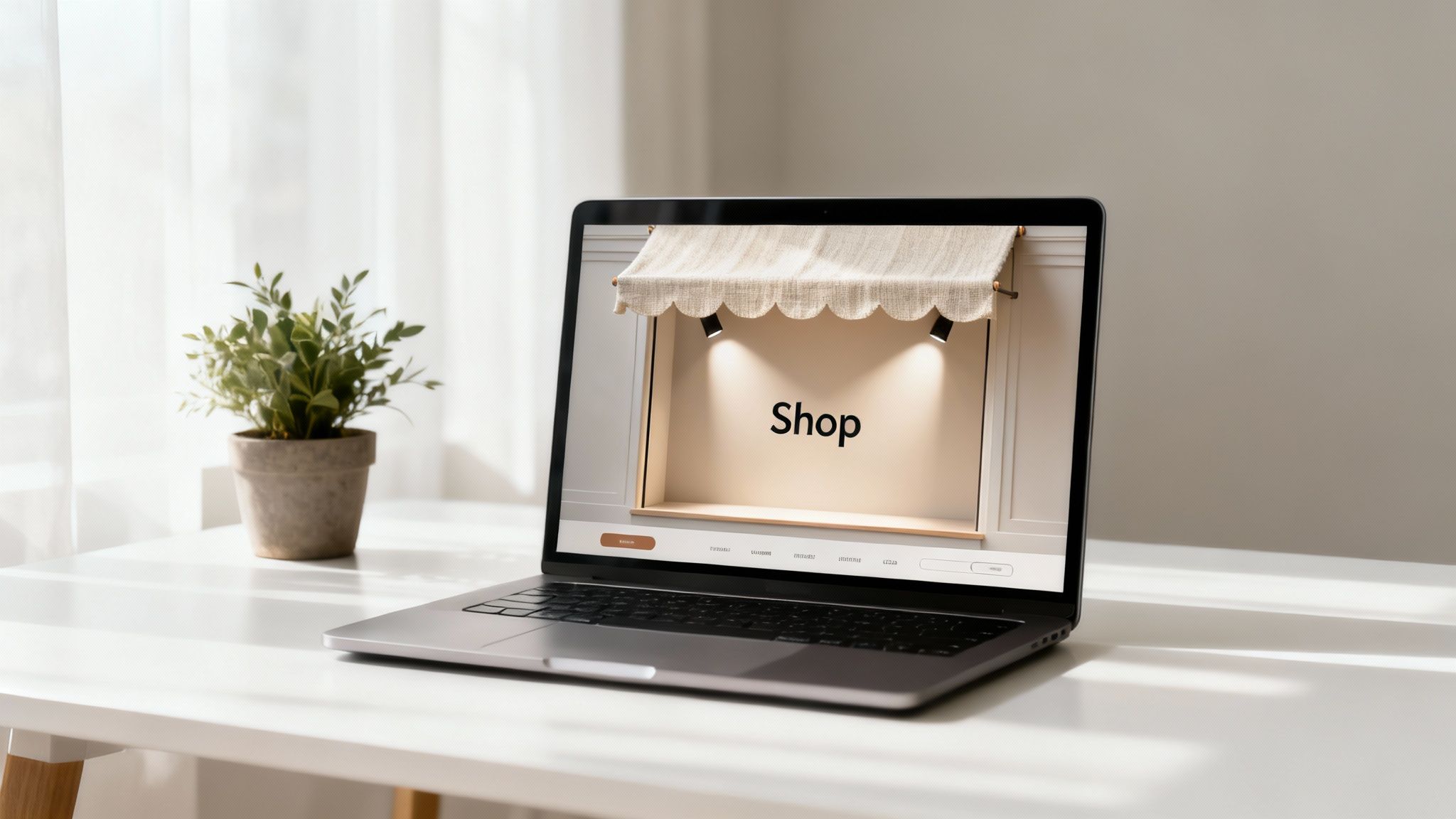
In today’s digital-first economy, your website is your brand experience. This is where you make your first impression, tell your story, and ignite long-term customer relationships. Simply having an online presence is table stakes. To win, you must own your digital space with a site that performs as beautifully as it looks.
High bounce rates and low conversion numbers are not just metrics. They are direct signals of a disconnect between what you offer and what your audience experiences. Strategic ecommerce web design closes that gap. It transforms a passive browse into an engaging journey, guiding users seamlessly from discovery to checkout.
The Foundation of Growth
Your website's design is the architecture of your business growth. A powerful foundation supports every marketing campaign, product launch, and expansion plan. Without it, even the most brilliant strategies fail to gain traction. An optimised site is your single most powerful asset for:
- Customer Acquisition: A fast, intuitive, and visually compelling site ranks higher in search engines and converts ad traffic more effectively. This directly lowers your customer acquisition cost.
- Conversion and Sales: The right design choices build trust, simplify navigation, and create a frictionless path to purchase. These details are not minor—they directly influence the decision to buy.
- Brand Loyalty: A memorable and user-centric experience is what brings people back. It’s how you transform one-time buyers into lifelong brand advocates.
This is especially critical in Singapore's booming ecommerce market. The industry is projected to hit US$18.08 billion by 2025, with a steady annual growth rate of 10.3%. Your web design is your key to capturing the attention of 3.51 million active local shoppers who, by the way, have the region's highest average order value at $137.40. For more on this, check out the insights on Singapore's ecommerce growth on SellerCraft.
Moving Beyond Aesthetics
Exceptional ecommerce web design is where art meets commerce, where creativity is guided by conversion science. It’s a disciplined process that puts user needs first while relentlessly pursuing your business goals.
Your website shouldn’t just win design awards; it should win customers. The ultimate measure of a successful ecommerce site is its ability to generate revenue and build lasting brand equity.
This guide empowers you to do just that. We'll deconstruct the core pillars of a successful online store: user-centric design principles, the science behind conversion, and the technical performance required to compete at the highest level. Strategic design isn't a luxury for market leaders; it’s the accessible path to becoming one.
The Blueprint For A High-Converting Experience
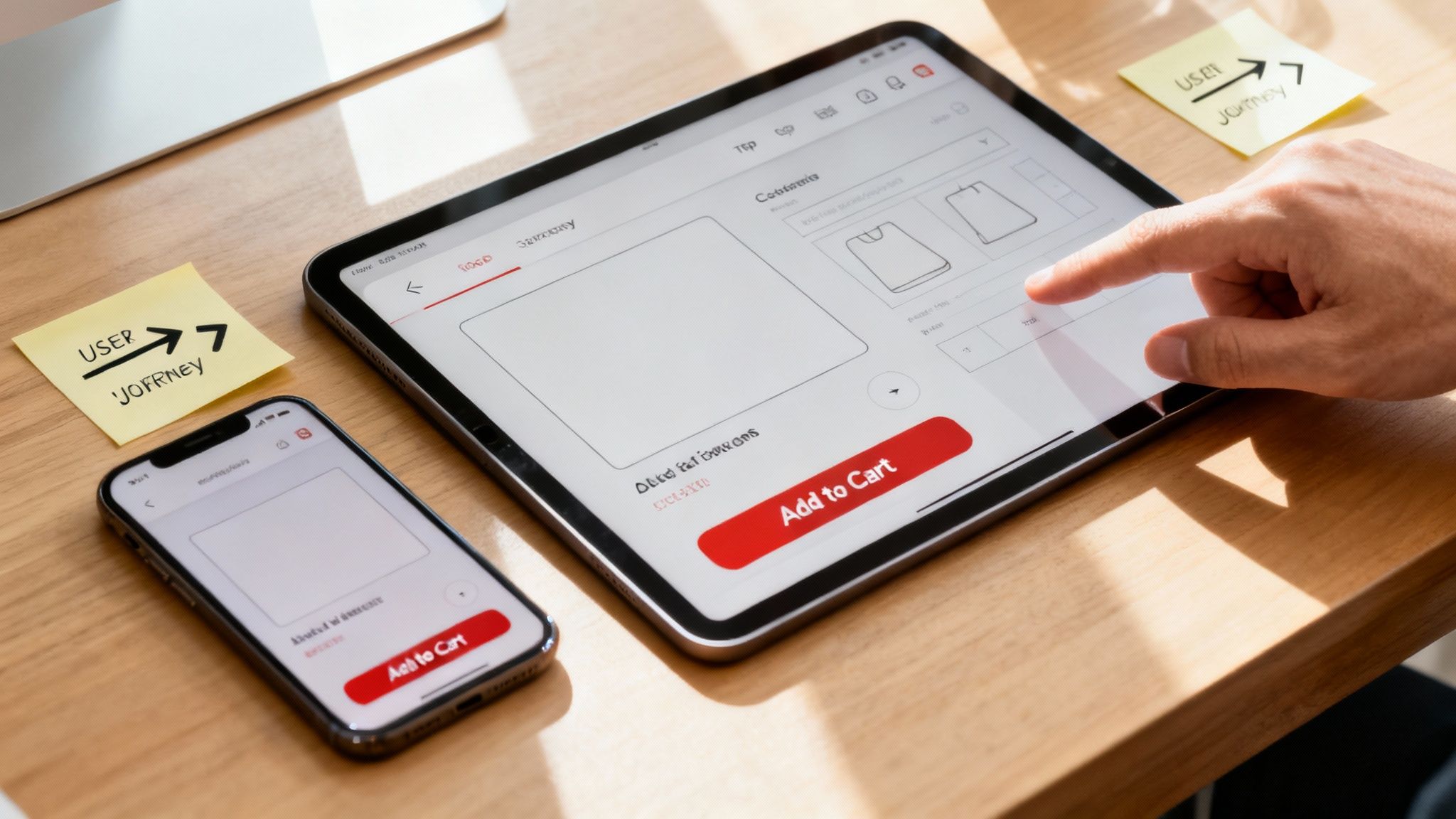
A great ecommerce website is more than a beautiful storefront. It’s an engineered experience, built from a deep understanding of customer psychology. The real magic happens when you move beyond aesthetics and start designing a journey that feels intuitive, engaging, and trustworthy from the first click.
That’s the difference between a store that simply exists and one that actively converts browsers into buyers.
The ultimate goal is to remove friction. Every element, from your homepage layout to the colour of the checkout button, must have a clear purpose: to guide the user smoothly to the next step. Think of it less like building a website and more like choreographing an experience—one that anticipates your customer’s needs and consistently exceeds their expectations.
This isn't about chasing trends. It's a strategic discipline where every design choice is a deliberate move towards a clear business outcome: more sales and fiercely loyal customers.
Intuitive Navigation And User Flow
Your site’s navigation is its central nervous system. It must be flawless. If shoppers cannot find what they want in seconds, they will leave. An intuitive navigation system feels effortless, guiding people to their destination without conscious thought.
The structure must feel logical and predictable. A well-organised site map, with clear categories and subcategories, is like the well-lit, clearly signed aisles of a physical store. It prevents frustration and empowers customers to explore your catalogue with confidence.
A few key elements of a seamless user flow include:
- A prominent, easy-to-use search bar: Many shoppers know exactly what they want and head straight for search. Ensure yours offers autocomplete suggestions and delivers relevant results, fast.
- Logical category hierarchy: Organise your products in a way that makes sense to your customers, not just your internal teams. Use breadcrumbs to show users exactly where they are on the site.
- A streamlined checkout process: Reduce the number of steps and form fields required to make a purchase. Every extra click is another opportunity to abandon the cart.
Compelling Visuals And Brand Storytelling
In ecommerce, your visuals do the heavy lifting. Customers cannot physically touch your products, so your photography and videos must build trust and convey value. High-quality, professional images are your digital handshake.
But it goes beyond product shots. Your site’s entire visual identity—its colour palette, fonts, and imagery—tells your brand’s story. A consistent and compelling visual language builds an emotional connection with your audience. This is how you elevate a simple transaction into genuine brand affinity. It's where you can explore and implement stunning Shopify web designs that truly capture your brand's unique personality.
The most powerful e-commerce experiences don’t just sell products; they sell a feeling, a lifestyle, or a solution to a problem. Your design is the primary vehicle for that narrative.
To get this right, you need to balance several core design pillars. Each one influences user behaviour in a specific way, ultimately pushing them closer to making a purchase.
Core Pillars of Conversion-Focused Design
| Design Pillar | Core Principle | Impact on Conversions | Key Metric to Track |
|---|---|---|---|
| Clarity & Simplicity | Remove distractions. Make the user's path to purchase obvious and easy to follow. | Reduces bounce rates and decision fatigue, leading to higher completion rates. | Bounce Rate, Exit Pages |
| Visual Hierarchy | Use size, colour, and placement to guide the user's eye to the most important elements. | Directs attention to CTAs and key product information, accelerating the journey. | Click-Through Rate (CTR) |
| Trust & Credibility | Display social proof, security badges, and professional imagery to build confidence. | Lowers purchase anxiety and cart abandonment by reassuring the user. | Cart Abandonment Rate |
| Compelling CTAs | Design buttons that are visible, use action-oriented text, and create a sense of urgency. | Increases the likelihood of a user taking the desired next step, like "Add to Cart". | Conversion Rate |
| Mobile-First Design | Ensure a seamless, intuitive experience on smartphones and tablets first, then scale up. | Captures the majority of traffic, as most online shopping starts on mobile. | Mobile Conversion Rate |
By focusing on these pillars, you create an environment that doesn't just look good but is scientifically designed to encourage buying behaviour.
Driving Action With Clear Calls-To-Action
Every page on your site needs a clear purpose. That purpose culminates in a call-to-action (CTA) that tells the user exactly what to do next. Buttons like "Add to Cart," "Buy Now," or "Sign Up" are far more than design elements; they are the critical decision points in the customer journey.
For any online store, figuring out how to improve website conversion rates is a constant process that directly impacts your bottom line. Effective CTAs are designed to be impossible to miss. They use action-oriented words ("Get," "Shop," "Join") and contrasting colours that pop off the page. Their placement is not random—it is strategically positioned right where a user is most likely to make a decision.
A well-crafted CTA removes ambiguity, simplifies the buying process, and puts your customer on the fast track to conversion.
Building For Peak performance On Shopify
A brilliant design is only half the battle; its real power comes from flawless execution. For ambitious brands, Shopify offers a solid foundation, but hitting peak performance means building your digital flagship with a smart, deliberate approach. This isn’t about piling on more features—it’s about architecting a store that’s both stunning and seriously fast.
The commerce architecture you build should simplify complexity, not create more of it. Many brands bloat their sites with countless third-party apps. Each one adds code, and together, they grind the user experience to a halt. This creates a painful trade-off between rich functionality and the site speed needed to make sales. A high-performing store strikes the perfect balance.
The strategic move is to curate an elite set of best-in-class apps and fill any gaps with custom-coded solutions. This delivers the exact features you need without the performance penalty of off-the-shelf bloat. The result? A clean, scalable, and powerful ecommerce engine truly built for growth.
Mastering Speed With Core Web Vitals
In a mobile-first world, speed is everything. Google’s Core Web Vitals are no longer just technical metrics; they are direct measures of user experience that influence your search rankings and, more critically, your conversion rates. Nothing kills a sale faster than a slow-loading site on a mobile device.
These vitals track three key aspects of the user journey:
- Largest Contentful Paint (LCP): How quickly does the most important content on the page appear? Your target is under 2.5 seconds.
- First Input Delay (FID): How fast does the page respond when a user first interacts with it? The goal is less than 100 milliseconds.
- Cumulative Layout Shift (CLS): How much does the page layout jump around while loading? A low score means a stable, predictable experience that builds user confidence.
Optimising for these metrics is not optional. It demands clean code, compressed images, and a smart strategy for loading assets. This is a fundamental pillar of customer-first ecommerce web design.
The Mobile-First Imperative
The vast majority of online shopping begins on a smartphone, which means your design process must start there, too. Adopting a mobile-first design philosophy ensures your site is perfectly tuned for the smallest screens, featuring touch-friendly navigation, readable text, and a frictionless checkout process.
Designing for mobile first forces discipline and clarity. It compels you to prioritise what truly matters, removing friction and focusing every element on guiding the user toward a purchase.
Once the mobile experience is perfected, you scale the design up for tablets and desktops. This approach guarantees a seamless experience for the majority of your audience, rather than treating them as an afterthought. With user penetration in Singapore projected to hit 80.4% by 2029, smart leaders know a clunky mobile site leads directly to abandoned carts. For a deeper dive into the platform itself, explore our guide on what Shopify is and how it powers modern retail.
Advanced Architecture For Scalability
As your brand grows, your technology must keep pace. For businesses pushing the limits of customer experience, an advanced setup like headless commerce offers unmatched flexibility and performance.
Headless commerce decouples your front-end presentation layer (the "head," or what customers see) from your back-end ecommerce engine (like Shopify). This allows you to build completely custom, lightning-fast storefronts using modern frameworks while still tapping into Shopify’s robust back-end for managing orders and logistics.
This API-driven strategy enables unique, content-rich experiences that a traditional theme cannot deliver. It's the ultimate setup for brands that refuse to be boxed in by templates and demand total creative control over their digital presence. Building this way ensures your platform scales with your brand, not against it.
Your Design Journey From Vision To Launch
Turning a great idea into a high-performing ecommerce website is a structured journey, not a leap of faith. It's a thoughtful, collaborative process that moves from big-picture thinking to pixel-perfect execution, transforming business goals into a tangible, revenue-generating asset. The path from concept to a live store is built on a series of deliberate phases, each building momentum on the last.
This journey demystifies the complexity of ecommerce web design. We break it down into a clear, manageable roadmap. The goal is a transparent partnership where every step has a purpose, ensuring the final product is not just beautiful but engineered from the ground up to drive real business results.
The Five Phases Of Development
A well-oiled design and build process is more than a checklist; it's a disciplined framework that ensures nothing is left to chance. It aligns our team with yours, creating a shared understanding of the objectives and the clearest path to achieving them. This structured approach prevents scope creep, manages expectations, and keeps the project moving forward with clarity.
The entire journey unfolds across five distinct yet interconnected phases:
- Discovery and Strategy: This is the foundation. We kick things off with deep dives into your brand, your ideal customer, the competitive landscape, and all technical requirements. The outcome is a strategic blueprint that guides the entire project.
- Wireframing and UX Design: With strategy in hand, we map out the customer journey. Low-fidelity wireframes act as the architectural plans for your site, focusing purely on structure, flow, and function before any visual design is considered.
- Visual UI Design: Once the blueprint is locked in, we bring the brand to life. This is where we apply your visual identity—colours, typography, and imagery—to create an engaging, intuitive, and memorable user interface that tells your brand’s story.
- Development and Integration: Our developers translate the approved designs into clean, high-performance code on the Shopify platform. This phase is also where we integrate essential third-party apps, payment gateways, and shipping solutions.
- Quality Assurance and Launch: The final leg involves rigorous testing across multiple devices and browsers to hunt down and squash any bugs. Once we confirm the site is stable, fast, and flawless, we manage the seamless transition to go-live.
This infographic breaks down the core performance principles that guide our development phase.
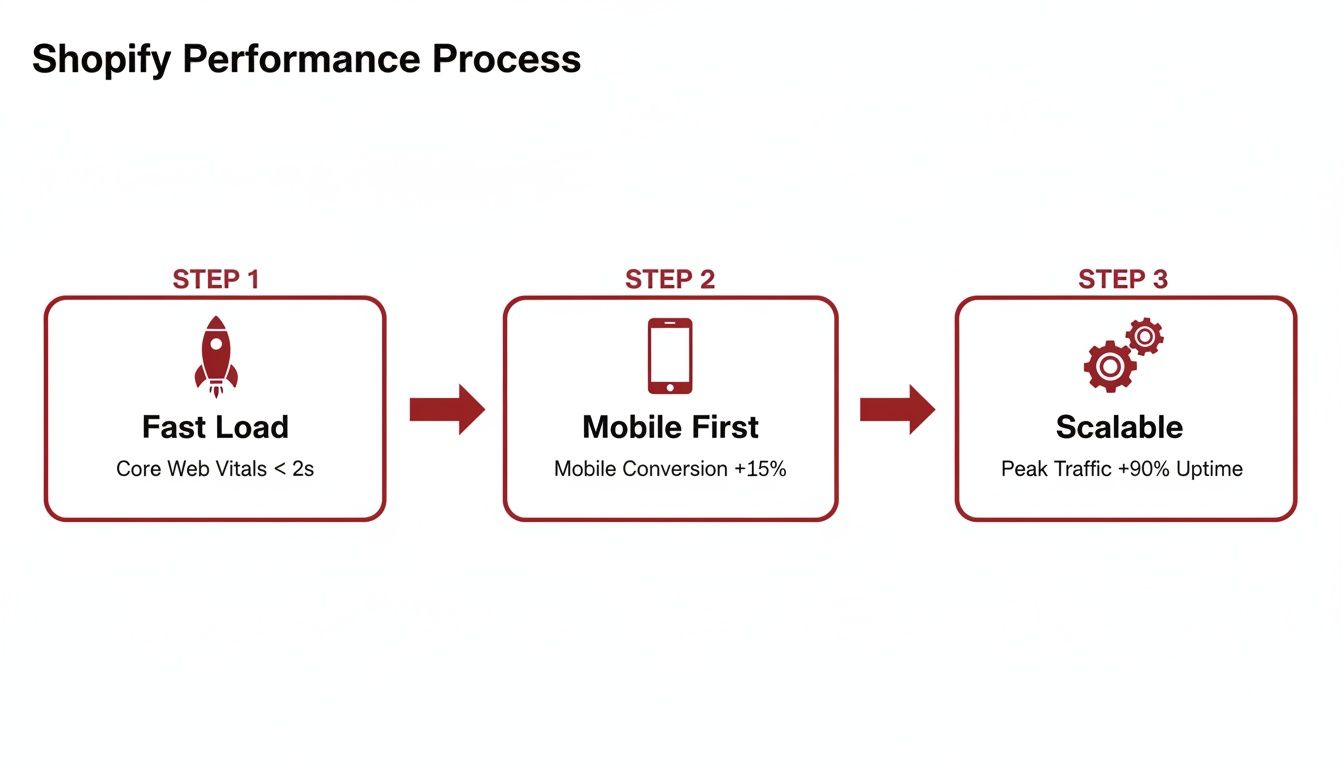
A successful launch isn't an accident. It's built on a solid foundation of speed, a mobile-first architecture, and a structure that can scale with you.
A Partnership Built On Momentum
This process isn't a rigid, one-way street; it's a dynamic collaboration. It thrives on open communication, regular feedback, and a shared commitment to excellence. A true growth partner doesn't just build what you ask for—they challenge assumptions, offer strategic insights, and become a dedicated extension of your team.
The goal is not just to launch a website. It is to launch the right website—one that simplifies complexity, empowers your team, and is built from day one to scale with your ambition.
By following a proven methodology, we turn what could be an overwhelming project into a series of clear, achievable milestones. This structured approach ensures every decision made along the way is purposeful, data-informed, and directly aligned with the ultimate goal: igniting sustainable growth for your brand.
Igniting Growth Beyond The Launch
Launching your site is not the finish line—it's the starting gate. The sharpest ecommerce brands know a website is never truly "finished." It is a living asset that must evolve with customer expectations and market dynamics. The real work begins now, shifting from building to continuous improvement, all guided by data.
This is the core discipline of Conversion Rate Optimisation (CRO). It’s a methodical process of refining your site's experience to increase the percentage of visitors who take a desired action, like making a purchase. It’s about asking the right questions, listening to your data, and making intelligent changes that directly impact your bottom line.
Optimisation is not just about fixing what’s broken; it’s about unlocking your brand's full potential. Every test is an opportunity to learn more about your customers and serve them better.
Listening To The Data
Your website analytics are a goldmine of behavioural insights. Tools like Google Analytics and heat mapping software tell a story about where users click, how far they scroll, and where they get stuck or abandon their journey. This is your first step towards building a powerful growth engine.
By digging into this data, you can pinpoint friction points in the customer journey. Is a specific page causing a massive drop-off? Is a critical call-to-action being ignored? These are not failures; they are signposts pointing toward your greatest opportunities for growth. Once your ecommerce site is live, focusing on proven strategies for online business growth is key to scaling your operations and ensuring long-term success.
This data-first mindset shifts you from guesswork to informed decisions, ensuring every change has a purpose.
From Insights To Actionable Hypotheses
Once you identify a problem area, the next move is to form a hypothesis. A good hypothesis is not a wild guess; it’s a clear, testable statement that proposes a specific change and predicts a measurable outcome. You are applying the scientific method directly to your ecommerce web design.
For example:
- Observation: "Our data shows a 70% drop-off rate on the product page for mobile users."
- Hypothesis: "By replacing the dropdown size selector with clickable buttons on mobile product pages, we will reduce friction and increase the 'Add to Cart' rate by 15% because the new design is more touch-friendly."
A well-formed hypothesis transforms a vague problem into a specific, measurable experiment. It’s the bridge between understanding user behaviour and taking decisive action to improve it.
With a clear hypothesis, you are ready to test. A/B testing, which shows different page versions to separate audience segments, is the gold standard for proving that your changes drive real, measurable improvements.
The Power Of AI In CRO
While a human eye is essential, AI-powered CRO audits can uncover deep insights we often miss. These advanced systems analyse massive amounts of data to spot subtle patterns in user behaviour, pinpointing "micro-frictions" that have a huge cumulative impact on conversions.
AI can analyse thousands of user sessions to reveal not just what is happening, but why. This dramatically accelerates the learning cycle, empowering you to move faster and with greater confidence. This is especially true in a market like Singapore, where the e-commerce surge to $11 billion GMV by 2025 demands the sharpest optimisation. With consumer electronics and furniture leading the charge, data-driven design is no longer optional for grabbing market share. You can learn more about Singapore’s ecommerce market dynamics on trade.gov.
Ultimately, continuous optimisation is the engine that drives sustainable growth. It creates a powerful feedback loop: you analyse data, form a hypothesis, test your solution, and feed those learnings back into your strategy. For even more ways to accelerate your revenue, learn how smart email marketing can unlock free-flowing cash for your business. This iterative process puts you in control of your store's performance and builds a resilient, customer-first brand.
How To Choose Your Ecommerce Growth Partner
Choosing a partner for your ecommerce web design project is one of the most critical investments you will make in your brand’s future. This isn't about hiring a vendor to build a website; it's about finding a strategic ally to ignite your next chapter of growth.
Get it right, and you create incredible momentum. Get it wrong, and you introduce friction that stalls progress entirely.
The decision goes far beyond a surface-level portfolio review. A beautiful portfolio is merely the price of entry. True growth partners are defined by deeper qualities that prove they can deliver tangible business results, not just vanity metrics. You need a team that thinks like a business owner, not just a designer.
This is how you make that choice with confidence.
Beyond The Portfolio
To identify a genuine growth partner, you must dig deeper into their methodology, expertise, and mindset. The gap between a good agency and a great one is their ability to connect every creative decision directly to your commercial goals. They don’t just ask what you want; they ask why and challenge assumptions to drive a better outcome.
Look for these non-negotiable qualities:
- Deep Platform Expertise: They must know their chosen platform—like Shopify—inside and out. This means understanding its limits and knowing exactly how to push beyond them with smart, custom solutions.
- A Proven Methodology: Ask them to walk you through their process. A real partner has a clear, transparent framework for everything, from initial strategy and discovery to post-launch optimisation.
- A Laser Focus on Business Outcomes: Listen to their language. A great partner talks about conversion rates, average order value, and customer lifetime value—not just colour palettes and fonts.
- A Truly Collaborative Team: They should feel like an extension of your own team. This means transparent communication, a shared passion for your vision, and an ego-free partnership.
The right partner doesn’t just build what you ask for. They bring strategic insights to the table, simplify complexity, and build a digital flagship designed to scale with your ambition.
For ambitious brands, this means partnering with experts like Jumpstart Commerce, the only Shopify Platinum Partner in Southeast Asia and in the top 1% globally. We build stores engineered for speed and conversion from day one. Our AI-powered CRO audits and custom apps are designed to solve complex customer journeys, turning high-intent traffic into loyal customers. This is crucial in a market with 96% internet penetration and where nearly 60% of consumers make online purchases weekly.
You can learn more about the ecommerce landscape in SG and MY on SellerCraft.
Choosing an agency is a commitment to a shared vision. When you find a partner who combines technical excellence with a relentless focus on your growth, you unlock the momentum needed to win in your market.
Your Ecommerce Web Design Questions, Answered
As you dive into the world of ecommerce, questions will arise. Getting clear answers from experts in the field helps you sidestep common pitfalls and make smarter decisions for your brand. Here are the most common questions we encounter.
How Much Does An Ecommerce Website Cost?
The honest answer is: it varies dramatically. A straightforward site using a pre-built template might cost a few thousand dollars, while a fully custom, feature-rich build can extend well into six figures. The final price tag depends entirely on the scope and complexity of your vision.
Here’s what influences the cost:
- Custom vs. Template: A unique, custom design has a higher upfront investment than adapting a theme. The trade-off is a site that perfectly embodies your brand and delivers a superior user experience.
- Feature Complexity: Every custom feature, third-party integration (like connecting to an ERP or CRM), and specialised app adds to the development time and overall cost.
- Agency vs. Freelancer: Partnering with an established agency is typically a larger investment. You are paying for a dedicated team, battle-tested processes, and strategic guidance that a lone freelancer often cannot provide.
Think of it not as a cost, but as an investment in your single most important sales channel.
How Long Does The Design Process Take?
For a professional ecommerce build, a realistic timeline is anywhere from 12 to 16 weeks. This spans the entire journey from initial strategy to final launch. A simple, template-based site can sometimes be completed faster, but a highly customised build with complex integrations will require a more extended timeline.
The timeline is a direct reflection of a disciplined process. Rushing the strategy, UX design, or testing phases almost always leads to a weaker final product that requires costly fixes down the line.
A sensible timeline is not about delay; it’s about ensuring every stage—from wireframing and design to development and quality assurance—receives the focus it needs to build a high-performing digital flagship.
What Makes A Good Ecommerce Website?
Aesthetics are only one piece of the puzzle. A truly great ecommerce website excels in three critical areas:
- It’s User-Centric: The site is incredibly easy to use. Navigation feels natural, product discovery is simple, the search function works flawlessly, and the checkout process is frictionless—especially on mobile.
- It Builds Trust: Shoppers need to feel secure before they will part with their money. This confidence is built through high-quality product photography, clear descriptions, genuine customer reviews, and visible security badges. It all signals, "You're safe here."
- It’s Fast: Speed is non-negotiable. Every page must load in under three seconds. A slow site kills engagement, tanks conversion rates, and damages your search engine rankings.
Ultimately, the best ecommerce sites are conversion engines. They are meticulously engineered to guide a visitor from discovery to purchase without friction.
Ready to build an ecommerce experience that doesn't just look good but drives real business growth? As the only Shopify Platinum Partner in Southeast Asia, Jumpstart Commerce designs, builds, and grows high-performing stores for ambitious brands. Discover how we can help you scale smarter and win globally.






Leave a comment
This site is protected by hCaptcha and the hCaptcha Privacy Policy and Terms of Service apply.